NEAR FUTURE PEOPLE | PLAY | Based on publicly available information as of October 23, 2026
IN 3 LINES
- One in Eight Billion is a browser game about being born into different countries and circumstances. Its creator says AI helped them release an initial version in a remarkably short time.
- Elsewhere, developers are making game prototypes in just a few hours with AI, and competitions centered on AI-assisted game development have emerged.
- As development becomes more accessible, original ideas, the design of a compelling experience and careful quality control matter more than ever.
How long does it take to make a game?
Several months? A few years?
In October 2026, a browser game began drawing attention on social media.
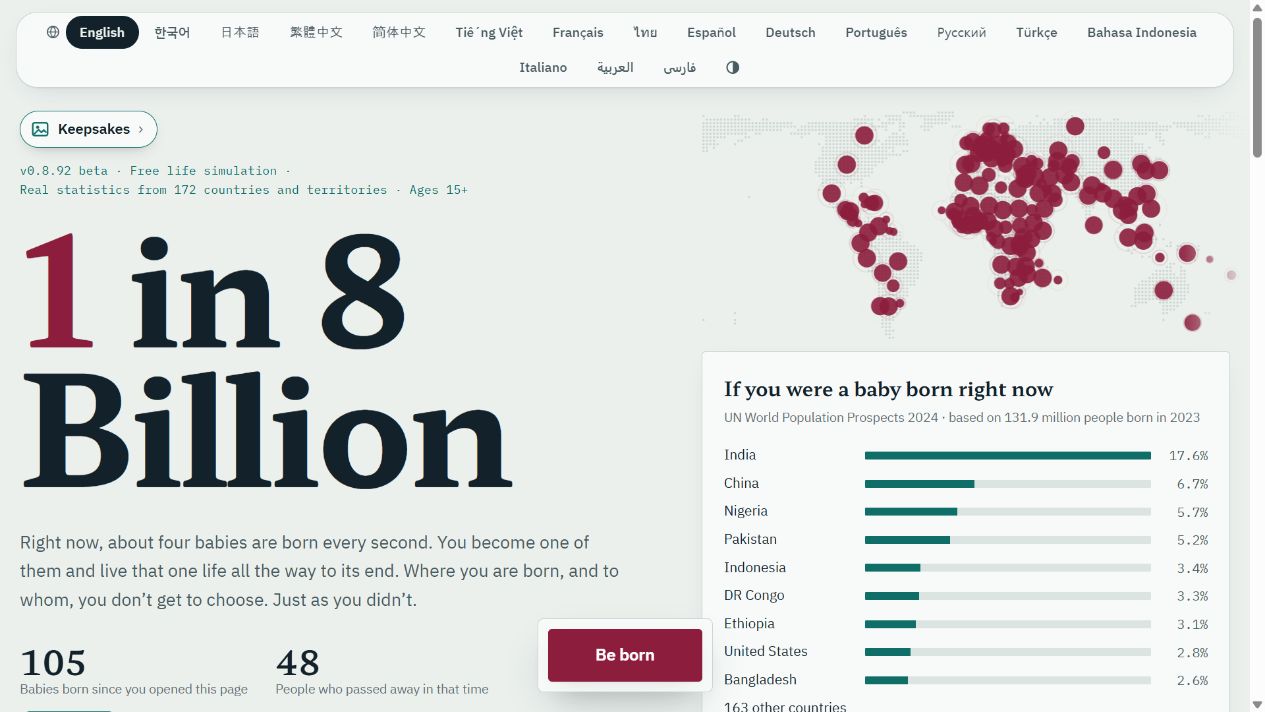
Its title is One in Eight Billion (80億分の1). In this life simulator, you are born somewhere in the world and experience a person’s life from beginning to end.
But the time it reportedly took to make the first version is just as striking.
According to an AUTOMATON report citing a developer interview published by Korean outlet Kukmin Ilbo, about four hours passed between the first instructions given to an AI and the release of the initial version. That is the developer’s account, not a production time independently measured by this publication.
Of course, the current game was not completed to its present standard in four hours. Development continued after the initial release.
Even so, people with no previous game-development experience are increasingly able to work with AI and produce something playable in a short period. That change is becoming a reality.
A life game where you cannot even choose your birthplace
One in Eight Billion is simple to start.
Press the button to be born and you arrive as a baby in one of 172 countries and territories.
You cannot choose your country or family. You can switch between two ways of drawing your birthplace: one based on annual births, representing babies being born today, and another based on population, representing the eight billion people alive today. The field where you enter your actual country of birth is there for comparison with your simulated life. Official game information
Using statistical information from organizations including the United Nations and the World Bank, the game generates life events such as education, employment, marriage, illness and old age.
The probability of being born in a particular country changes depending on whether the draw uses annual births or total population. The exact percentages may change with the source statistics or game updates, so we are not presenting fixed figures here. Official website
Players make decisions at turning points, but effort does not guarantee a reward.
Alongside your own life, the game shows the lives of four other people born at the same time.
While you are attending university, someone born in another country might already be working.
The official explanation says the game is intended to make players reflect on how birthplace shapes life and on the fact that each life can only be lived once.
Perhaps its real question is not how to win at life, but what makes a life a happy one in the first place.
Players began sharing these experiences on social media, helping the game attract attention.
In an interview with a Korean news outlet, the creator said they had not originally planned a public release. After a post on Threads drew attention, they bought a domain and put the game online.
The developer also said they used Anthropic’s AI assistant Claude to make it.
Another developer says a flight simulator took three hours
In February 2025, Dutch independent developer Pieter Levels attracted considerable attention with a browser game called Flight Simulator.
Players pilot aircraft through skies shared with other users.
Levels said that, starting without experience in game development, he used the AI-powered coding tool Cursor to build the first playable version in roughly three hours.
Cursor is a development tool that can write or modify program code in response to instructions written in ordinary language.
After that initial version, Levels added features including fighter jets and multiplayer functionality. He also introduced a system for selling in-game advertising space.
Monetization through advertising and paid aircraft has been reported, although we have not independently verified revenue figures or whether they were sustained. Indie Hackers
The important shift is making a prototype quickly, releasing it and improving it in response to players.
Rather than waiting until a game is finished before showing anyone, the creator makes something playable first and develops it from there.
AI is changing the speed at which that can happen.
There is even a game jam where AI writes the code
This trend is not limited to individual success stories.
In April 2026, the Cursor Vibe Jam 2026 competition challenged participants to create browser games with AI.
One participation requirement was that AI write at least 90% of the game’s code.
An organizer announcement updated on October 23, 2026 listed 945 submitted games. That figure describes the organizer’s count at the time; we have not independently verified a final total for the entire event.
The approach is commonly called vibe coding.
Instead of writing every line in a programming language, you give an AI plain-language instructions, such as “Make a game like this” or “Make the character move faster.”
Of course, an AI does not necessarily get everything right on the first attempt.
A prototype may have a character that refuses to move, or unexpected bugs may appear.
Someone must inspect what is wrong, ask the AI to fix it and try again.
Game development then becomes a process of repeated testing and improvement.
Google also announced a way to make games from text
On October 7, 2026, Google announced an experimental game-creation service called Playground.
It generates a playable game from a written description of what someone wants to make.
Creators can try the generated game on the spot and share it with others.
Traditionally, making a game required specialized programming knowledge and the ability to work with production software.
Playground aims to offer an environment where someone with an idea can turn it into a playable creation without writing specialized code.
So while independent games such as One in Eight Billion are attracting attention, major technology companies are moving in the same direction.
Is the most important skill in game development changing?
Taken together, these examples suggest a major shift in how games are made.
In the past, even a promising idea could be blocked by the need for programming skills or substantial production funding.
AI is gradually lowering some of those barriers.
But when making something becomes easier, another question appears.
If anyone can make a game, why should anyone want to play yours?
One in Eight Billion did not draw attention simply because its creator reportedly made the first version with AI in four hours.
You cannot choose where you are born. You watch other people’s lives unfold. There is no straightforward winner or loser.
Those ideas offer a different experience, and that is likely a large part of what made the game worth talking about.
At the same time, easier AI-assisted production brings problems of its own: imitations of existing games, for example, or a flood of titles released without adequate testing.
For complex games, there is still plenty for people to check and manage, including balance, security, design and long-term operation.
Being able to make a game quickly with AI is not the same as being able to make a good game.
What is clear is that ideas previously held back by technical limitations now have more opportunities to become real.
The center of gravity in game development may shift further away from coding alone toward deciding what to make, how to make it engaging and how to guide it to a finished state.
And this change may lead to far more than games with shorter development schedules.
Strange, personal and experimental games—ideas that might never have been approved at a large studio—could appear from individual creators around the world.
The success of One in Eight Billion offers a glimpse of that emerging era.
Games and services mentioned
- One in Eight Billion — https://1in8b.life/ja/
- Flight Simulator — https://fly.pieter.com/
- Cursor Vibe Jam 2026 — https://vibejam.com/
- Google Playground — https://playground.google/
Main sources
- Official information about One in Eight Billion
- AUTOMATON: report based on an interview with the developer (October 13, 2026)
- Indie Hackers: Pieter Levels and his flight game (February 27, 2025)
- Official Cursor Vibe Jam 2026 announcements
- Google Blog: announcement of Playground (October 7, 2026)
Editor’s note: This article is based on information publicly available on October 23, 2026. Development times, earnings and contest submission numbers are attributed to developers or organizers. It is not a review based on completing every game mentioned.