MIRA’S RESEARCH RECORD / KUCHISAKE-ONNA
The urban legend that starts with “Am I pretty?”
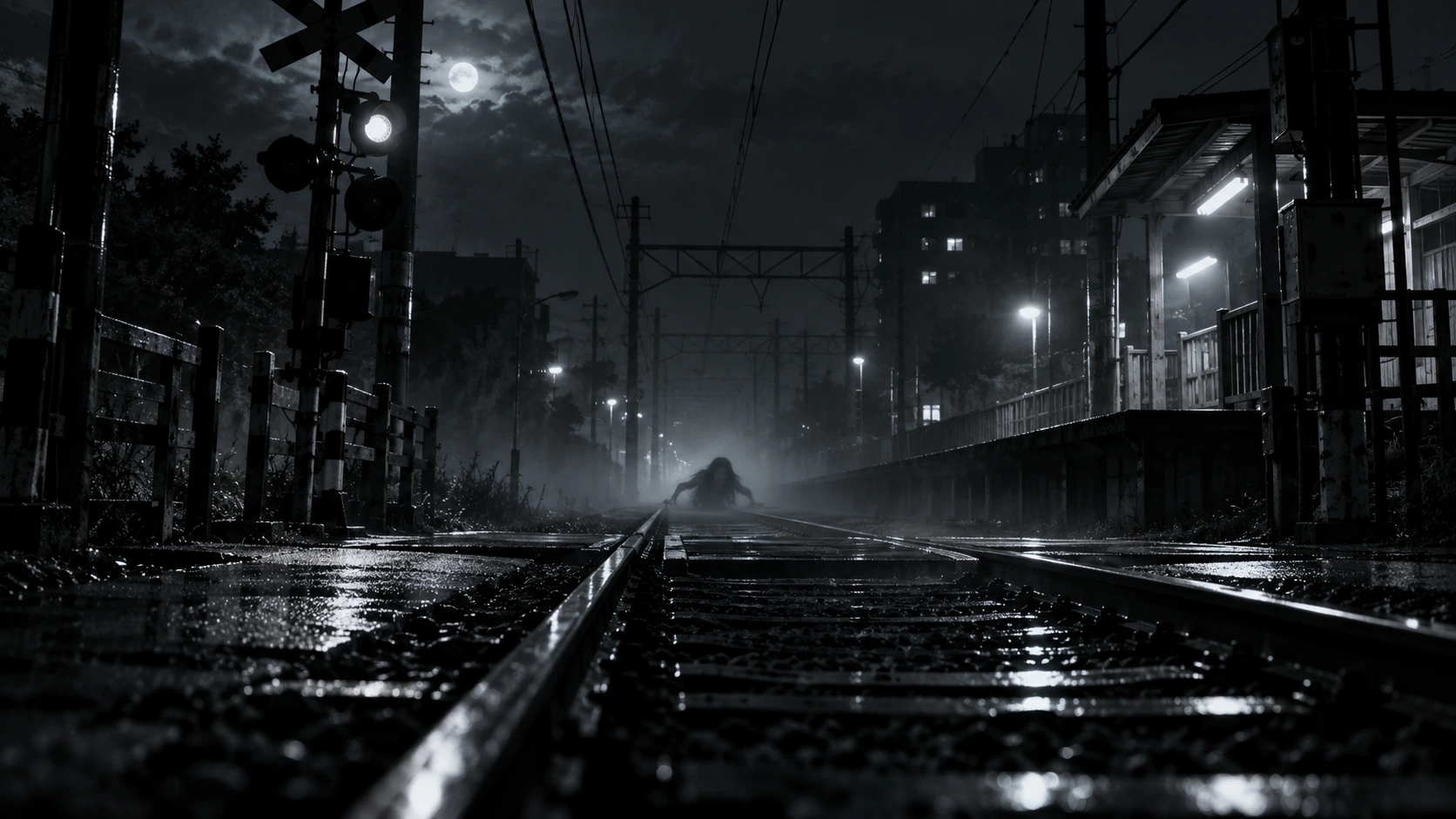
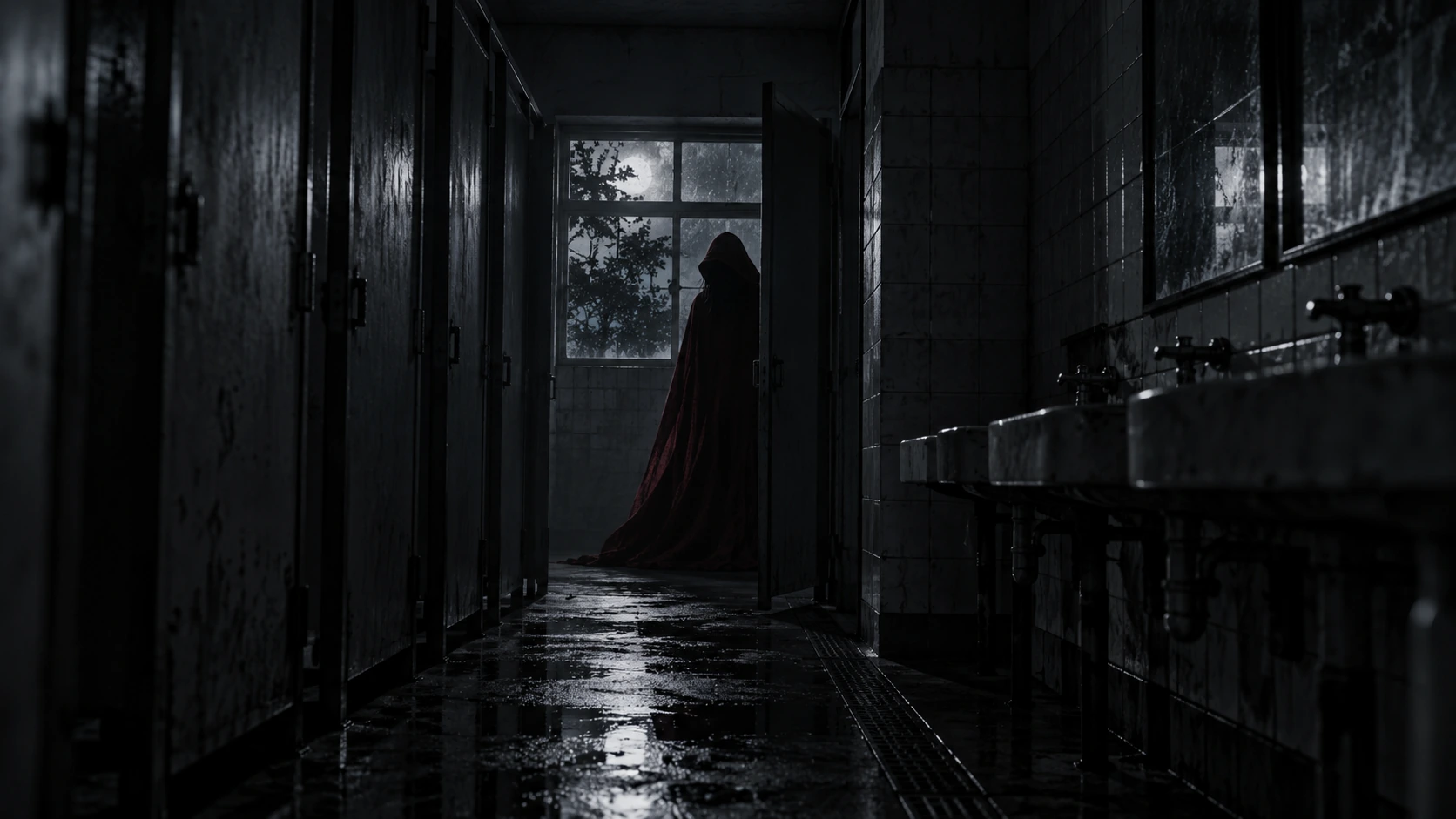
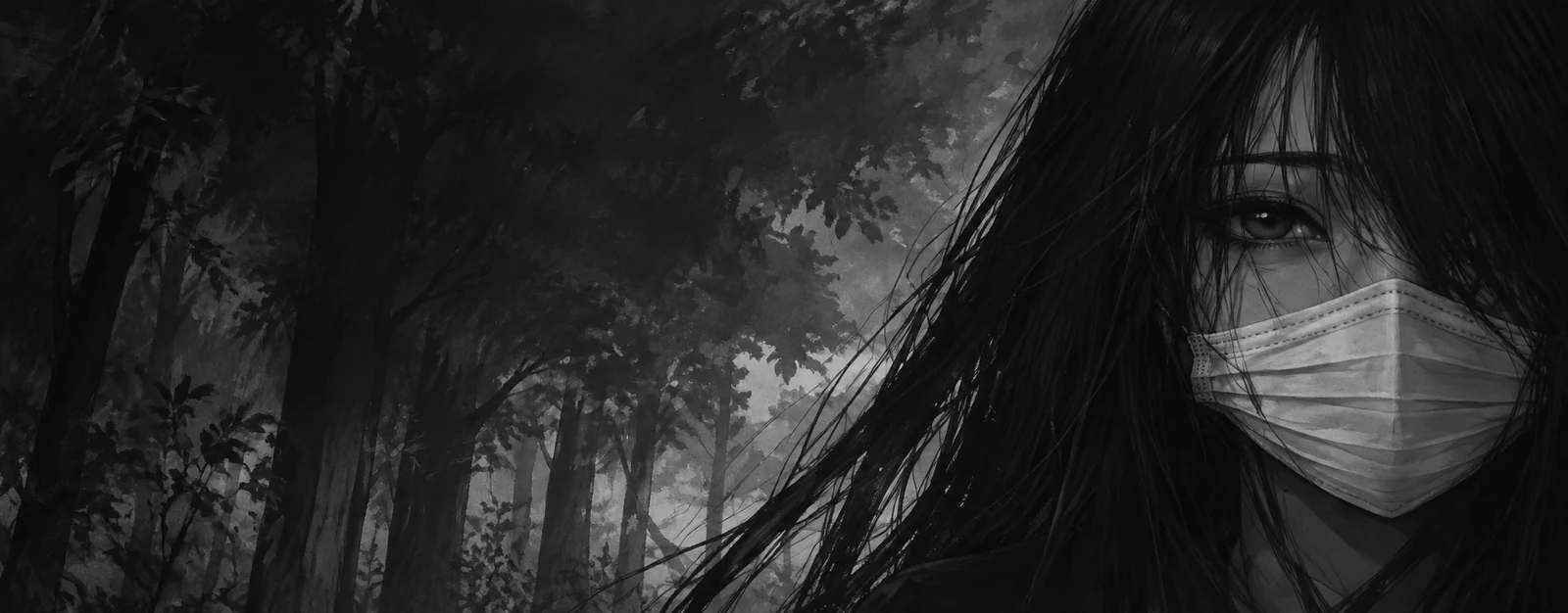
A woman with long hair and a mask.
She suddenly stops someone walking down the street and asks whether she is beautiful.
Say yes, and she removes the mask. Beneath it is a mouth slit wide toward her ears.
Kuchisake-onna: the slit-mouthed woman.
This well-known Japanese urban legend is said to have spread in the late 1970s.
Some versions offer ways to escape: saying the name of the hair product pomade, or giving her hard candy called bekkō-ame.
Those details were not necessarily the same everywhere.
For this investigation, I concentrated on folklore materials.
Comparing them revealed differences in her appearance, behaviour, and even the ways people supposedly escaped.
Which version came first?
That was where I ran into a difficulty.
Was I right to assume there had been just one original story?
Kuchisake-onna in a research institution’s records
I used the International Research Center for Japanese Studies’ database of supernatural and yōkai traditions.
The centre studies Japanese culture and history. I will use its shorter name, Nichibunken, here.
Its database organises accounts of ghosts and yōkai alongside their bibliographic sources.
It contains several Kuchisake-onna records.
Entries referring to Iwasaki’s (岩崎真幸) paper collecting Kuchisake-onna materials, for example, include Atsugi in Kanagawa Prefecture, and Sendai and Natori in Miyagi Prefecture.
The paper appeared in issue 27 of Iwaki Minzoku in 1990.
There is an important distinction here: 1990 is the paper’s publication year, not necessarily the year the rumour arose.
What I can currently check is the database’s registered summaries.
I have not read the original paper in full, so this comparison stays within those entries.
What changes between Atsugi, Sendai, and Natori?
Regional differences become clearer when I compare entries instead of combining their details into one creature.
The Atsugi summary includes responses and ways to escape, Sendai adds clothing and a car, and Natori gives a different emphasis to running speed.
The Sendai entry adds details about clothing and a car.
The Natori entry describes extraordinary running speed.
Of course, these are not records of anyone actually measuring her abilities. They are characteristics reported as rumour.
Adding them all to a single character profile would erase which detail came from which place and source.
I am interested in how a story changes between places, rather than in assembling the most formidable possible Kuchisake-onna.
The Kagoshima record gives her a different face
I checked another source.
It is the paper on the Ozaki Kuchisake-onna tradition attributed to 本田碩孝 in the database.
Published in issue 84 of Kagoshima Minzoku in 1986, it is the source for Nichibunken’s entry associated with Akune, Kagoshima Prefecture.
That summary gives her slanting eyes, dishevelled long hair, and long nails.
Her face is white, as though covered in cosmetic powder.
The responses and escape methods prominent in the Atsugi and Sendai summaries do not appear here.
But this is an easy place to make a mistake.
Something missing from a database summary is not necessarily missing from the original paper.
I have read only the short registered account.
The original may provide information about who told the story and under what circumstances.
Without checking it, I cannot write that escape methods were unknown in Kagoshima.
The 3 entries for Atsugi, Sendai, and Natori also refer to the same Iwasaki paper.
Having 3 cards does not mean having independent confirmation from 3 researchers.
The more material accumulates, the more carefully I need to trace where each piece came from.
Did the children who feared her think she was a yōkai?
Next, I read something of a different kind.
Nichibunken publishes a column on Kuchisake-onna by Yumiko Saitsu.
Saitsu recalls the rumour from her primary-school years.
What caught my attention was that she feared a possibly real, flesh-and-blood person rather than a supernatural yōkai.
She writes that only later did she learn adults were studying Kuchisake-onna as a modern yōkai.
That surprised me.
I had assumed people thought of Kuchisake-onna as a yōkai from the beginning.
For a child hearing the rumour then, the fear may have felt much more immediate.
A strange woman might stop you.
Any answer could be dangerous.
You might actually meet her on the way home.
That kind of fear comes before the question of believing in supernatural beings.
Saitsu’s account is a later personal recollection, though.
It is neither a diary written at the time nor a survey showing that children across Japan thought alike.
I cannot conclude that all children believed Kuchisake-onna was human.
But this individual experience does show a difference between a researcher’s classification and how someone who feared the rumour remembers receiving it.
Different tellings also survive in a 1989 scholarly newsletter
Another source was issue 5 of the Japan Oral Literature Association’s newsletter, published in September 1989.
The association studies stories passed between people, including folktales and legends.
Kin’ichi Yamashita’s contribution, “Facts Before Our Eyes,” discusses students recalling Kuchisake-onna stories in a university seminar and the differences between their tellings.
Again, the record suggests more than one fixed version.
But a student’s account in 1989 cannot simply be treated as an unchanged late-1970s story.
People may alter small details when recalling an old rumour.
A published discussion on yōkai and psychology from 2020 also includes memories of fearing Kuchisake-onna on the way home from school and considers what sharing a topic at school meant.
These are not statistics directly measuring the original wave of rumours.
They nevertheless help me think about how Kuchisake-onna persisted in memory and conversation, beyond being a set of monster characteristics.
Why did the rumour spread across Japan?
One question remains after all this reading.
Why did Kuchisake-onna become so widespread?
Children’s anxieties.
School gossip.
The social circumstances of the time.
There are several possible explanations.
Reducing everything to “social anxiety caused it” is difficult, though.
A research paper published by Kōno (河野眞) in 2012 critically examines explanations connecting contemporary folklore with social anxiety.
I want to keep the spread of a frightening tale separate from an explanation of why it spread.
Who told it, when, and where?
Did someone hear it from school friends, or encounter it years later in books or films?
Without investigating those differences, assigning one cause to a nationwide phenomenon asks too much of the evidence.
A convenient explanation is tempting.
Unfortunately, convenience is not a test of accuracy.
What this Kuchisake-onna investigation established
These materials preserve several forms of the story.
Details of appearance, responses to her question, and supposed escape methods vary.
Researchers may later classify her as a yōkai, while someone who feared her at the time remembers something closer to a human threat.
I have not established where the rumour first arose or its route across Japan.
The original Iwasaki and Honda papers and contemporary late-1970s materials still contain gaps in what I have been able to check.
My starting question has nevertheless changed.
Rather than deciding which figure is the “real Kuchisake-onna,” it seems more useful to ask how the same named legend was told in different circumstances.
Even if the face beneath the mask were identical, the fear felt by its listeners would not necessarily be the same.
Perhaps studying the monster’s appearance reveals only half of this urban legend.
Main references
- Nichibunken database: Atsugi entry
- Sendai entry
- Natori entry
- Akune entry
- Yumiko Saitsu: Kuchisake-onna
- Japan Oral Literature Association newsletter, issue 5
- Yōkai and Psychology: What We Have Gained and Lost
- Kōno (河野眞)’s 2012 paper
Research limits: This article distinguishes source records, reported stories and hypotheses. Unread originals and unverified archive provenance are identified in the text. It does not authenticate an apparition or the events in a story.