IN 3 LINES
- Drawquarium is scheduled to launch on Steam November 13; it remains unreleased on November 12.
- Its official features include drawing fish and plants, importing PNGs, wallpaper mode and organizational tools.
- Connecting creation with care is its interesting proposition, but improved focus and comfortable performance are not verified outcomes.
Instead of selecting a beautiful fish, put an imperfect line of your own into an aquarium. Feed it and watch it grow. Drawquarium proposes turning a drawing from something to look at into something to look after. As of November 12, Steam lists a November 13, 2026 release, with byKaleb developing and rokaplay publishing. This is a prelaunch examination of official materials, not a review of an already released product. An exact Japanese unlock time has not been verified. Official product page
In the product introduction, creator Kaleb describes working as a 3D artist in the film industry and wanting to bring his children’s drawings to life. The significant possibility is not simply a larger selection of drawing tools. It is a shift from comparing the polish of an image to spending time with something a player made. Our arguments below are interpretations of documented features and creator statements. We have not played the game or verified how its fish respond during sustained use.
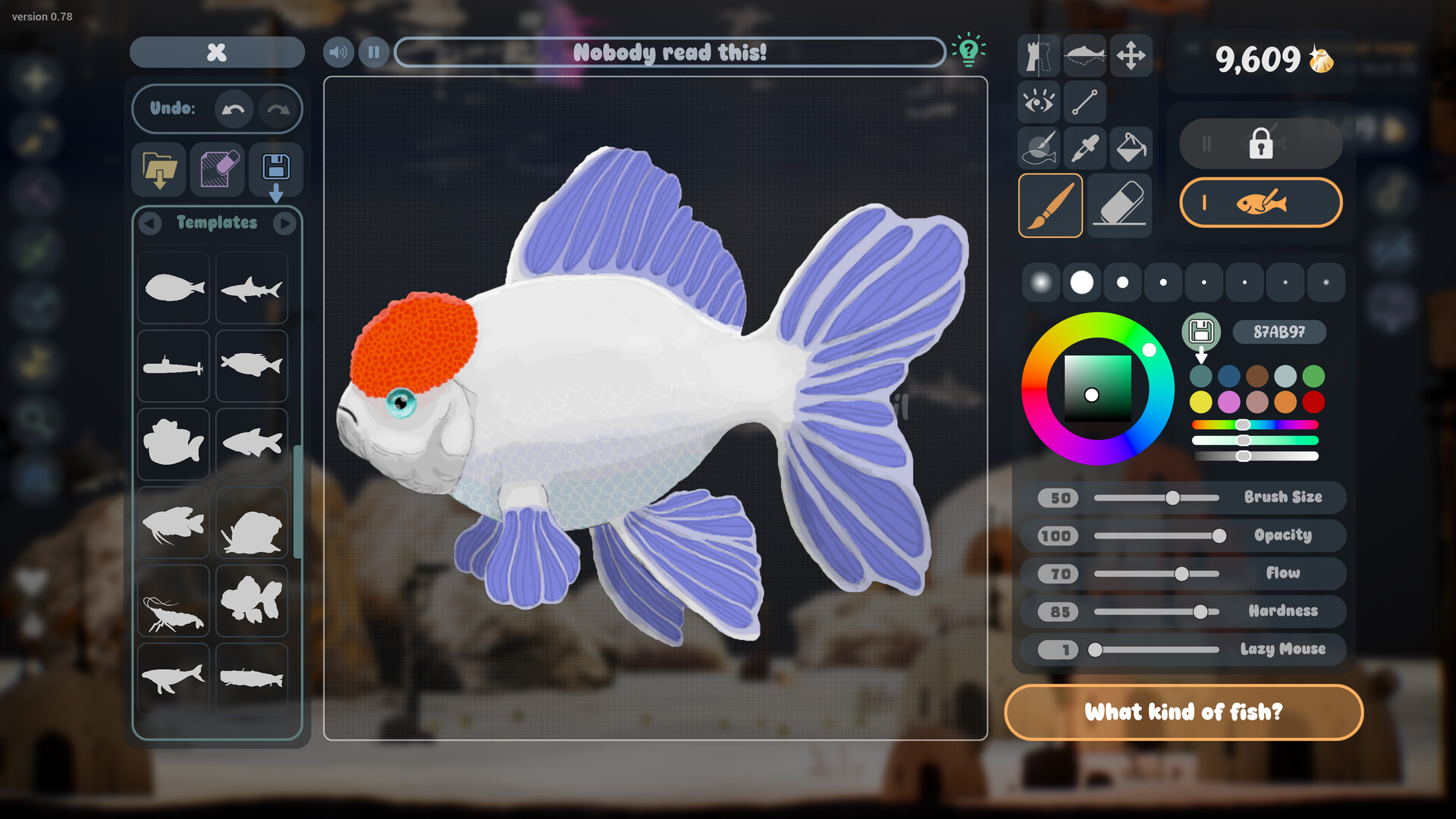
Official prerelease screenshot, version 0.78 as displayed: the fish editor. ©2026 Kaleb Lechowski. Developer: byKaleb; publisher: rokaplay. Unaltered; not a final-feature guarantee or our gameplay capture. — Source
A loop beyond making a picture swim
The official description connects drawing fish and plants with feeding, growth and collecting golden scales to unlock decorations and tools. Sand, lighting, rocks and driftwood offer ways to shape the surrounding tank. It also advertises friendships, rivalries, relationships and offspring among fish. Those are product claims, not our observations of a tested simulation. The text does not establish exactly how those relationships are calculated or how much complexity players will perceive in their behavior over time.
PNG importing offers another entry point alongside drawing inside the game. An earlier creation can potentially become part of the aquarium instead of requiring a new image made with its tools. Technical import capability, however, does not grant permission to use someone else’s artwork. A person sharing images involving family members or other creators should still consider their wishes and relevant rights. Respect for creation includes this distinction between what software can ingest and what a user is entitled to reuse or distribute.
Publisher rokaplay also describes drawing and raising fish while unlocking aquarium customization. This supports the central loop of making, caring and arranging a place. Its cozy positioning should nevertheless be read as a description of intended experience, not evidence of a universal psychological effect. A feature can aim to be calming without having been shown to reduce stress for every user. Genre, marketing language and measured outcomes answer different questions, and should not be collapsed into one favorable assessment. Publisher introduction
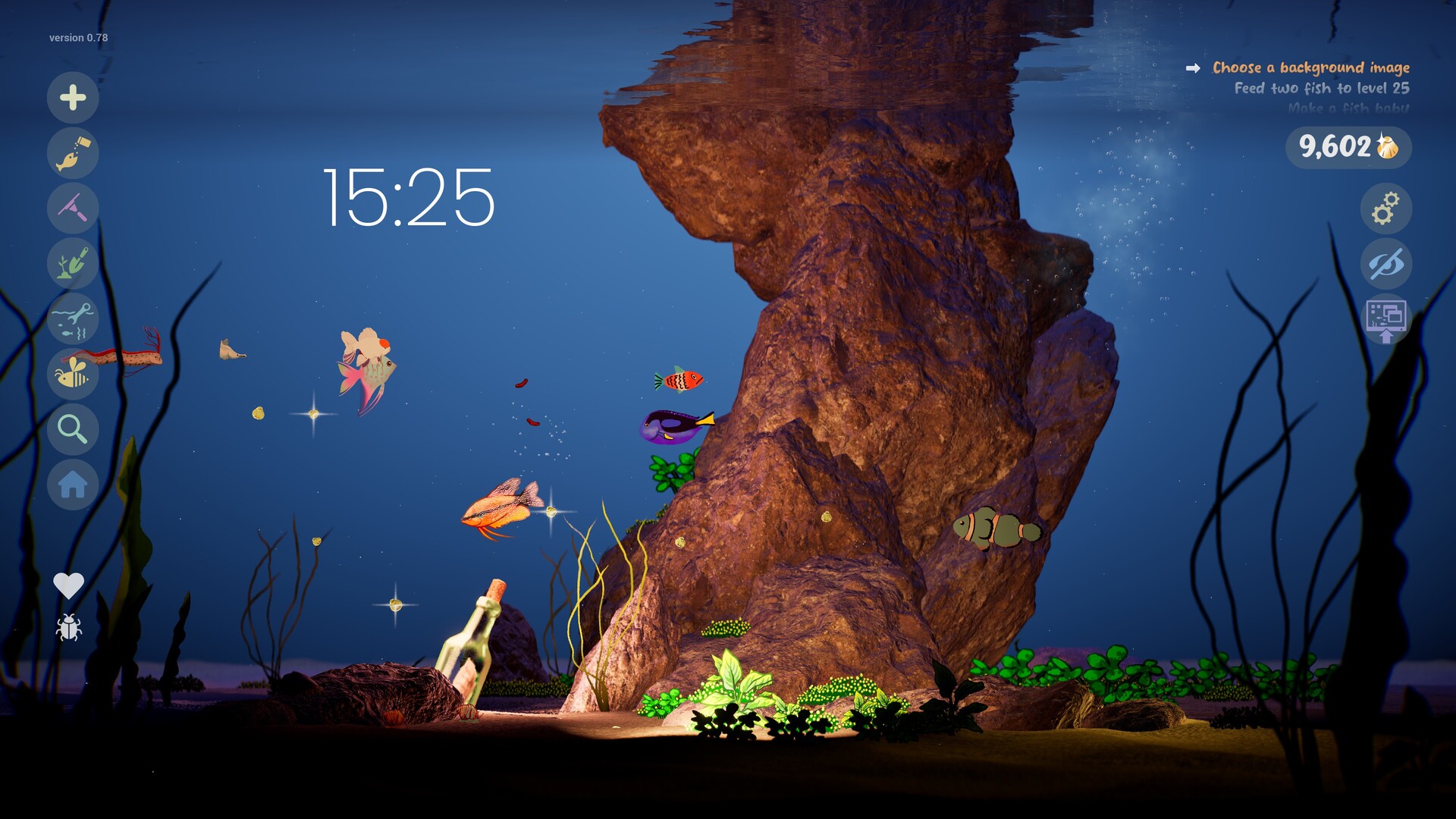
The official screenshots collected for this article show a fish editor with templates at left and color and brush settings at right, and a separate aquarium view with a clock. Both display version 0.78. They make the relationship between drawing tools and life in the tank visible, but they are published prerelease screens, not proof of every interface or feature in the final product.
A creator’s intention to preserve something imperfect
In an official community post dated November 3, Kaleb describes an idea arising while making paper sea turtles with his children during a family holiday: what if a painted fish could enter a virtual tank? The post also sets out his commitment to human creativity and the meaning of personally made, imperfect work. This is a creator’s account of development and values. It should not be treated as a survey establishing what the entire games audience wants, or as independent verification of every production decision. November 3 creator post
The same post says he removed templates at the beginning so players would first experience a scribble of their own coming alive. Meanwhile, the product page advertises templates and ready-made fish. Reading the statements together does not establish that all templates have permanently disappeared. An intended opening experience and assistance available elsewhere in a product are different things. We have not verified the final unlocking sequence, and should not convert that uncertainty into a promise that a particular option is immediately available.
The distinction provides a useful way to understand the intention. Supporting a beginner and asking that beginner to make an initial mark need not be contradictory. Yet an invitation to draw can still be intimidating. Someone who dislikes producing even a first rough shape might find the opening less comfortable than its creator hopes. Respecting the stated purpose does not require declaring the introduction successful before testing it. Both the invitation and the assistance need to be assessed through the actual interaction.
Analysis: from obtaining a rare fish to visiting your fish
Aquarium progression does not begin with Drawquarium. Ben Reber’s Chillquarium, released in 2023, describes buying fish, raising them in real time, selling them for profit or keeping them for income, and collecting species and color variants. This is a useful comparison of reasons to return to a tank, not an attempt to rank two unplayed experiences. Both use aquatic care and collection, but the source of a fish’s significance can differ. Chillquarium’s official description
Our first argument is that combining personal drawing with care could make rarity an incomplete measure of value. A fish created from one’s own marks might become worth visiting because of the memory attached to its creation. The creator’s account of family drawings and the advertised feeding-and-growth loop support that reading. The game could offer time with a creation rather than only a means of producing more creations. This is a proposition about how documented actions connect, not proof that players inevitably form attachments.
That could provide a route for someone who does not consider themselves an artist. Making one strange fish and watching it move need not involve competing to produce a polished image. An awkward shape might help the tank feel personally recognizable. But the appeal depends on preference and the effort of drawing and interaction. We are not making a scientific claim that self-made images reliably produce stronger affection, nor asserting that a player’s artistic discomfort disappears simply because a drawing is animated.
A reasonable counterargument concerns progression incentives. If collecting scales and unlocking decorations dominate attention, a personally drawn fish might still become an efficient unit in a reward system. Authorship alone cannot make repetitive care enjoyable. Responses need to communicate life in a way the player values, and waiting needs to fit their preferred rhythm. An emotionally persuasive development story and the quality of repeated interaction therefore require separate judgments. The former can explain the invitation without proving the latter will sustain it.
Analysis: wallpaper mode takes play beyond closing the game
The second distinctive connection is desktop presence. Official materials describe observing, feeding and playing with fish while doing other things in wallpaper mode. They also list a journal, task manager, timer and customizable clock. Together, these features position the aquarium alongside work rather than only after work. The question is not merely how many utilities are included. It is what kind of attention the aquarium will request when it occupies the same space as a document, browser or study task.
Our interpretation is that visibility could reduce the effort required to revisit a creation. A player might notice a moving drawing and briefly care for it without setting aside a dedicated session. Drawing and growth supply something to return to; wallpaper and organizational tools provide an everyday context for returning. The potential value could lie in repeated short encounters rather than one long stretch of play. That inference follows from the combination of features, not from a measured account of how people actually divide their time.
It does not follow that concentration improves. A stronger desire to check the fish could make returning to work harder for some people. Whether care supports a restorative break or creates another obligation depends on feedback, prompts and individual habits. Including a timer is not evidence of increased productivity. A pleasant companion and an effective focus tool are not automatically the same thing.
Performance is another separate question. Steam lists 64-bit Windows 10, eight gigabytes of RAM and graphics such as a GTX 1060 or RX 580 among its requirements. Running in the background does not establish negligible resource use on every machine. Compatibility with a work application’s demands, multiple monitors or a drawing tablet cannot be decided from the requirements table alone. Those are questions to examine on the intended setup, rather than reasons to assume that a small-looking aquarium imposes a small computational cost.
When trying wallpaper mode, assess the appearance of the fish separately from how easily ordinary windows and necessary controls remain usable. Choosing a placement that suits daily work is part of evaluating persistent play. Establishing that a feature works is a different judgment from deciding that its arrangement is something a person wants to use every day.
A demo is an entrance, not a final specification
Steam offers a free demo whose description discusses drawing, feeding, growth and customization. Similar wording does not prove that the demo contains every full-game feature or the latest opening sequence. It is an entry point for checking whether making an image and seeing it move feels comfortable. The scheduled November 13 date should also remain distinct from a promise about a specific regional unlock hour, which has not been established here. Readers can check the live store listing nearer release. Official demo page
The records contain a small chronological inconsistency worth preserving. Steam’s demo listing gives April 18, while the creator’s November account says the demo was released in May. We could not determine whether those refer to different distribution moments or updates. We therefore do not assert one definitive starting date for the demo. Resolving the history by guesswork would add false precision without helping readers find what they can access now. Current demo availability and the planned full release are the relevant practical distinctions.
Similarly, Windows requirements do not establish Mac or mobile support. Available content, language, device compatibility and purchase price each need their own check. The creator’s position on human expression also should not become a claim that every production stage has undergone an external audit, or that it proves anything about the legitimacy of another game. His values are relevant to the design explanation; extending them into broad, unverified claims would make the article less accurate rather than more insightful.
Drawquarium’s interesting question is whether a person wants to spend time with something they made, even when it looks imperfect. To assess that appeal, look beyond the first moment a fish starts swimming. The more revealing moment may come after doing something else: is there a reason to return to this particular creation? If making an image becomes the beginning of a small everyday relationship rather than its completion, the aquarium will have added something that a more polished picture alone cannot supply. That persistence is what remains to be judged after release.