MIRA’S RESEARCH RECORD / KOKKURI-SAN
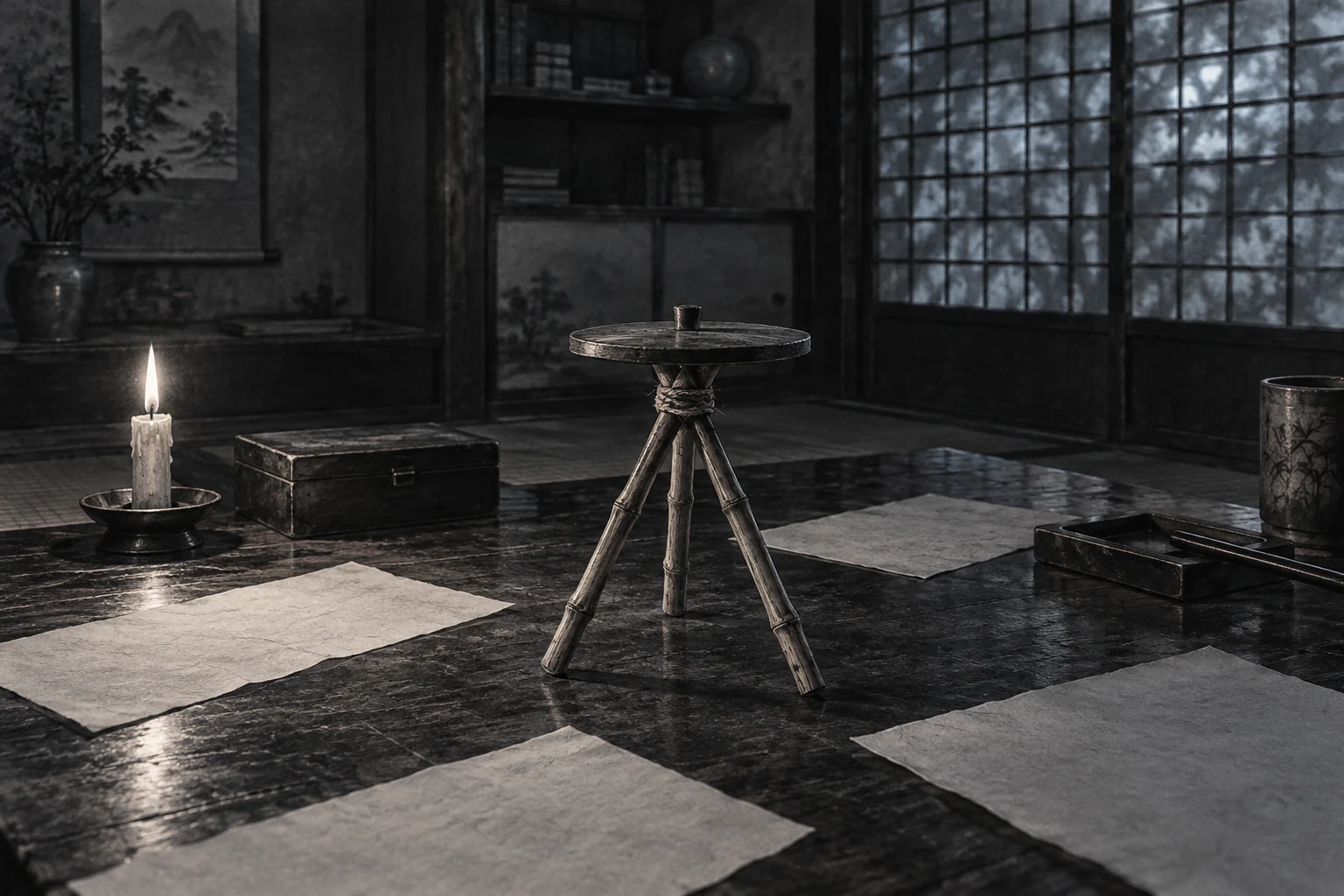
The strange game in which a coin seems to move by itself
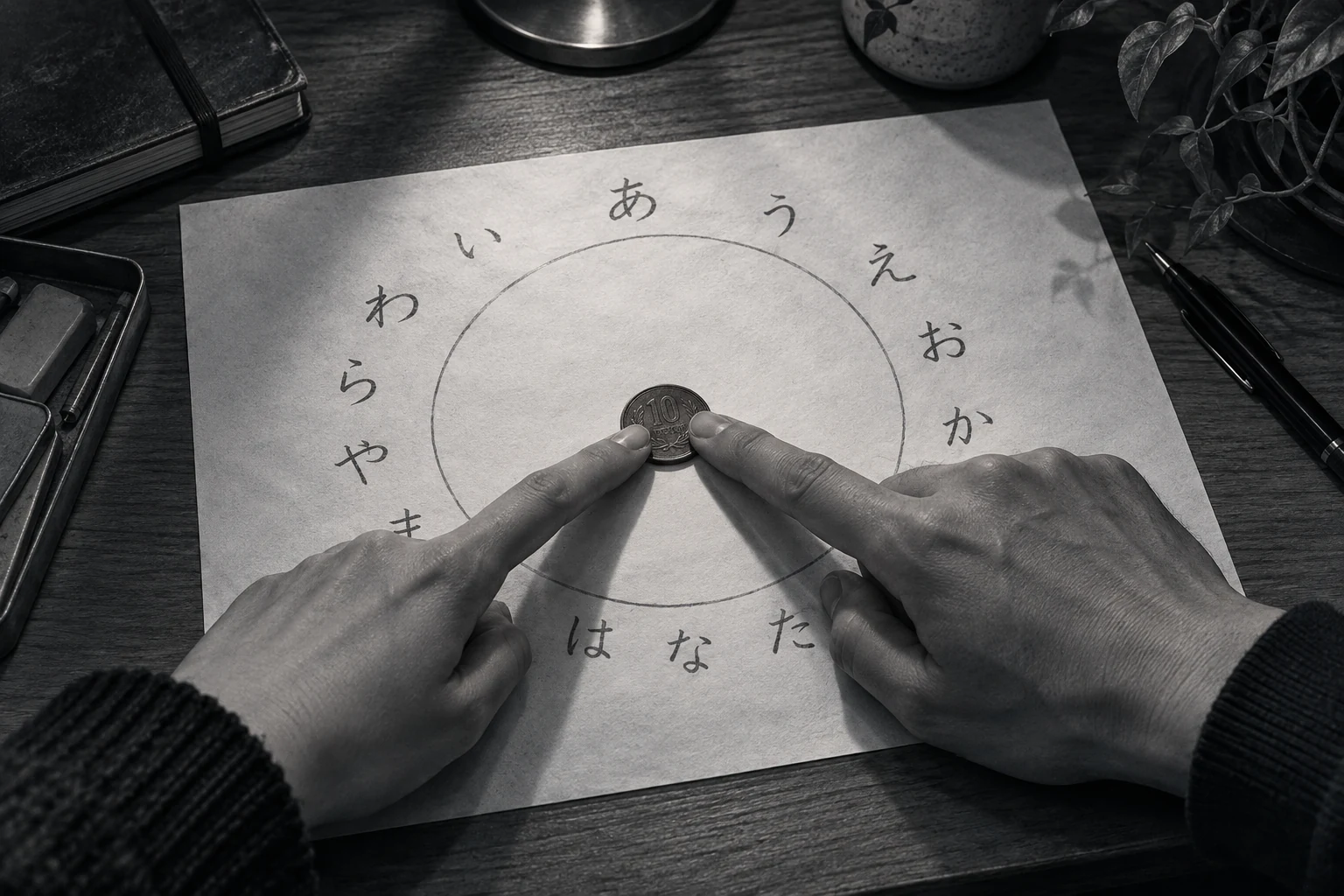
Write characters on paper, place a coin on it, and have several people touch the coin lightly.
Ask a question, and it appears to move by itself, pointing to characters.
Kokkuri-san.
It is a divination game familiar from Japanese school ghost stories.
Even people who have never tried it may recognise the name.
There are two broad puzzles here.
Why does something people are touching seem to move on its own?
And why do stories arise about its answers being correct?
Those may sound similar, but they are separate problems.
I looked at material ranging from a Meiji-era book to modern psychology experiments.
What emerged was a surprisingly long history of investigations of Kokkuri-san and related phenomena.
The meaning of each result also changes with what the experiment actually tested.
Meiji-era Kokkuri-san used different equipment
I began with Inoue Enryō’s Yōkai Gendan.
Enryō was a Meiji-era philosopher, also known as the founder of what is now Toyo University. He sought rational explanations for yōkai and other puzzling phenomena.
Written in 1887, Yōkai Gendan is now available through Aozora Bunko.
Aozora Bunko is a free electronic library mainly publishing works whose copyright protection has expired, including literary and scholarly writing.
My first surprise was that this was not the familiar coin-and-letter-board version.
Enryō mainly describes a device made from 3 pieces of bamboo supporting a lid or similar object.
Participants put their hands on the lid. When questions were asked, the device tilted or rotated.
Its direction and number of movements were read as answers.
Even the bamboo’s length, the way it was tied, and the lid apparently differed by locality.
It is quite a different scene from the coin version I had pictured.
The same name does not mean the equipment was always the same.
Did it really arrive from overseas?
Kokkuri-san is sometimes described as an import.
A catalogue concerning Enryō, publicly available from Toyo University, describes its arrival through Shimoda.
Enryō’s own text makes the situation look less straightforward.
Sections 14 through 17 of Yōkai Gendan discuss an account involving a foreign ship, but some of that information is hearsay.
The explanation that foreign equipment was replaced with different objects in Japan also includes Enryō’s own conjecture.
Enryō recording an account of its arrival is different from establishing the route through shipping records or similar evidence.
A later introduction may present something concisely. Returning to its source can change how certain it looks.
I want to remember that distinction.
The more plausible a history sounds, the more curious I become about who actually checked it first.
What did Enryō think made it move?
How, then, did Enryō explain the movement?
In Yōkai Gendan, deliberate manipulation alone does not account for everything.
He connects contact between hands and equipment with expectation and muscle movements the participant does not notice.
A key term is fukaku kindō: muscle movement outside a person’s awareness.
For instance, strongly expecting something to move right might allow a little force into the hands without any deliberate intention to move it.
If that small movement reaches the object, someone could feel that it moved despite having no recollection of moving it themselves.
Modern psychology sometimes describes such unconscious movements as ideomotor actions.
Ideas or expectations are expressed as bodily movement without a clear intention to act.
Enryō’s account cannot simply be treated as an established modern experimental result, though.
He acknowledges that some physiological points remain conjectural because they have not been sufficiently tested.
He was proposing an explanation, not claiming every part had been experimentally established.
I rather like that.
He tells the reader where his own explanation still needs evidence.
In 1853, Faraday investigated a related phenomenon
The British scientist Michael Faraday also investigated something resembling Kokkuri-san.
Known for his work on electromagnetism, he studied table-turning in 1853.
People placed their hands on a table, which was said to move through a mysterious force.
I consulted his letter to the editor of The Times and a reprinted report of the experiments.
Faraday placed boards and other materials between hands and table to investigate the order and direction of movement.
Small rollers between stacked boards, for example, allowed the boards to shift according to the direction of the applied force.
The displacement offered a way to distinguish whether the hands moved first or the table did.
He also compared conditions in which participants could or could not see an indicator showing the direction of the force.
Why build such a cumbersome apparatus?
Because the mere fact that something moved does not identify the cause.
If the table pulled the hands first, the movement would need to show that.
If force passed from the hands instead, a different movement should appear.
Faraday arranged a way to observe the difference.
Right. That is interesting.
He did not simply announce that mysterious forces were impossible. He asked what moved first.
Faraday’s subject was a moving table, however, not Japanese Kokkuri-san itself.
His work does not directly establish everything about the modern Japanese game.
A 2012 experiment with a Ouija board
Now for modern research.
In 2012, Gauchou and colleagues published an experiment using a Ouija board.
A Ouija board is a Western divination device bearing letters, numbers, and answers such as “yes” and “no.” Participants touch a small pointer that moves across it.
There are similarities to Kokkuri-san, but the cultural background and precise methods are not identical.
Participants answered yes-or-no general-knowledge questions.
The experiment had 3 phases: ordinary answers, answers using a Ouija board while blindfolded, and another round of ordinary answers. The board questions included both previously answered and new questions. Accuracy was compared using the same questions answered by both methods.
Participants were led to believe another person was using the board with them, but during the test only the participant was touching the pointer.
There were 27 participants. After exclusions, including cases without interpretable responses, 21 participants’ results were analysed.
Then comes an intriguing set of numbers.
For questions participants rated as guesses rather than known answers, ordinary responses were about 50% correct.
Ouija responses, meanwhile, were 65% correct.
That sounds striking.
But concluding that the board knows the answers would be premature.
The researchers investigated whether knowledge a person did not believe they knew could be expressed through unconscious movement.
The figures come from a limited group under particular question conditions.
They do not mean the board predicts the future, or answers every possible question with 65% accuracy.
A 2017 study reported different results
Looking further, I found different results in a study published by Olson and colleagues in 2017.
They used a pendulum rather than a Ouija board.
Participants answered either verbally or through pendulum movements about whether they had detected a briefly presented visual target.
The first study recruited 80 people and analysed 63 participants who met its conditions.
The results were:
| Response method | Accuracy |
|---|---|
| Verbal | About 57% |
| Pendulum | About 53% |
Under those conditions, pendulum answers were not more accurate than ordinary ones.
The researchers also ran a further experiment with a more difficult task.
Verbal accuracy was about 51%, and pendulum accuracy about 50%, both close to chance.
Does that mean the 2012 study was wrong?
That conclusion would be too quick as well.
The 2012 study asked general-knowledge questions. The 2017 task involved detecting briefly displayed visual information.
The devices differed too: Ouija board and pendulum.
This was not the same experiment repeated under identical conditions.
The 2017 study did find something else interesting.
Pendulum responses showed less tendency to favour a particular answer.
But less response bias and greater accuracy are different things.
Comparing the numbers without that distinction can produce conclusions the experiments never established.
The comparison table is an editorial summary of the papers’ methods and results, not a reproduction of their figures or tables.

Movement and correct answers are separate problems
These materials leave at least four different questions about Kokkuri-san.
Did the equipment move?
Did the participant feel responsible for moving it?
Could an answer express knowledge they could not consciously recall?
And can the device correctly reveal facts that nobody knows, or predict future events?
Those questions are not interchangeable.
Enryō tried to explain the relationship between movement and the human mind and body.
Faraday experimentally investigated whether force originated with the hands or the table.
The 2012 study examined whether knowledge unavailable to conscious recall could appear through the pointer’s movement.
The 2017 study measured differences between pendulum and ordinary responses.
Each investigated something different.
Even when the subject is a mysterious moving object, I need to check what each source actually established.
At first, I thought explaining the movement would explain the whole Kokkuri-san puzzle.
Reading the research made that look much too simple.
Why something moves and why an answer is correct require separate explanations.
What this Kokkuri-san investigation established
I was able to compare Meiji-era equipment and rational explanations, 19th-century table-moving experiments, and modern Ouija-board and pendulum studies.
Within the material checked, there are useful clues to how unintended bodily movements can be experienced as mysterious events.
Modern results vary by task and conditions. They do not establish that divination answers become accurate in every situation.
I have located bibliographic information for Ikurō Anzai’s book on why Kokkuri-san answers seem correct, but have not read its text.
Pages of Toyo University’s catalogue also remain unchecked.
More research is needed before completing an account of its transmission or of modern Japanese Kokkuri-san.
Even so, I found something quite interesting.
Research on Kokkuri-san has not consisted solely of asking whether spirits exist.
How much do people notice about movements they make themselves? How much information do they possess without believing they know it?
Those are also questions about human awareness.
I started with a ghost story and somehow ended up in research on consciousness.
I admit I like this sort of detour.
Main references
- Inoue Enryō, Yōkai Gendan: Aozora Bunko edition
- Toyo University: CATALOG Inoue Enryō
- Michael Faraday, Letter to the Editor of The Times, 1853
- Faraday, Experimental Investigation of Table-Moving
- Gauchou et al., 2012: Expression of nonconscious knowledge via ideomotor actions
- Olson et al., 2017: Ask the pendulum: personality predictors of ideomotor performance
Research limits: This article distinguishes source records, reported stories and hypotheses. Unread originals and unverified archive provenance are identified in the text. It does not authenticate an apparition or the events in a story.