MIRA’S RESEARCH RECORD / TEKE-TEKE
Familiarity is not an origin date
People who recognise the name Teke-teke can still begin with different explanations: a school apparition, a railway story, or a sound remembered more clearly than a figure. A familiar outline is not necessarily the outline of the earliest record.
Rather than nominate a first tale, I compare records with identifiable sources: an account by a screenwriter, a collected school variant and research comparing a teller with former listeners. None verifies an apparition. Together they let us investigate how a story is selected, remembered and altered without pretending we already know where it began.
A 1994 production and a later recollection
Screenwriter Konaka Chiaki describes making the television episode Yōkai Teke-teke on his own website. He recalls encountering Teke-teke in several school-ghost-story books appearing around 1993–94 and describes a figure whose form was not fixed.
This is primary testimony about a creator’s reading and decisions, but it is retrospective. It does not provide a complete bibliography with page references for every book consulted. Evidence that a creator knew the figure through publications around that period is valuable; it is not evidence that no earlier oral or printed account existed.
A familiar setting could be a production choice
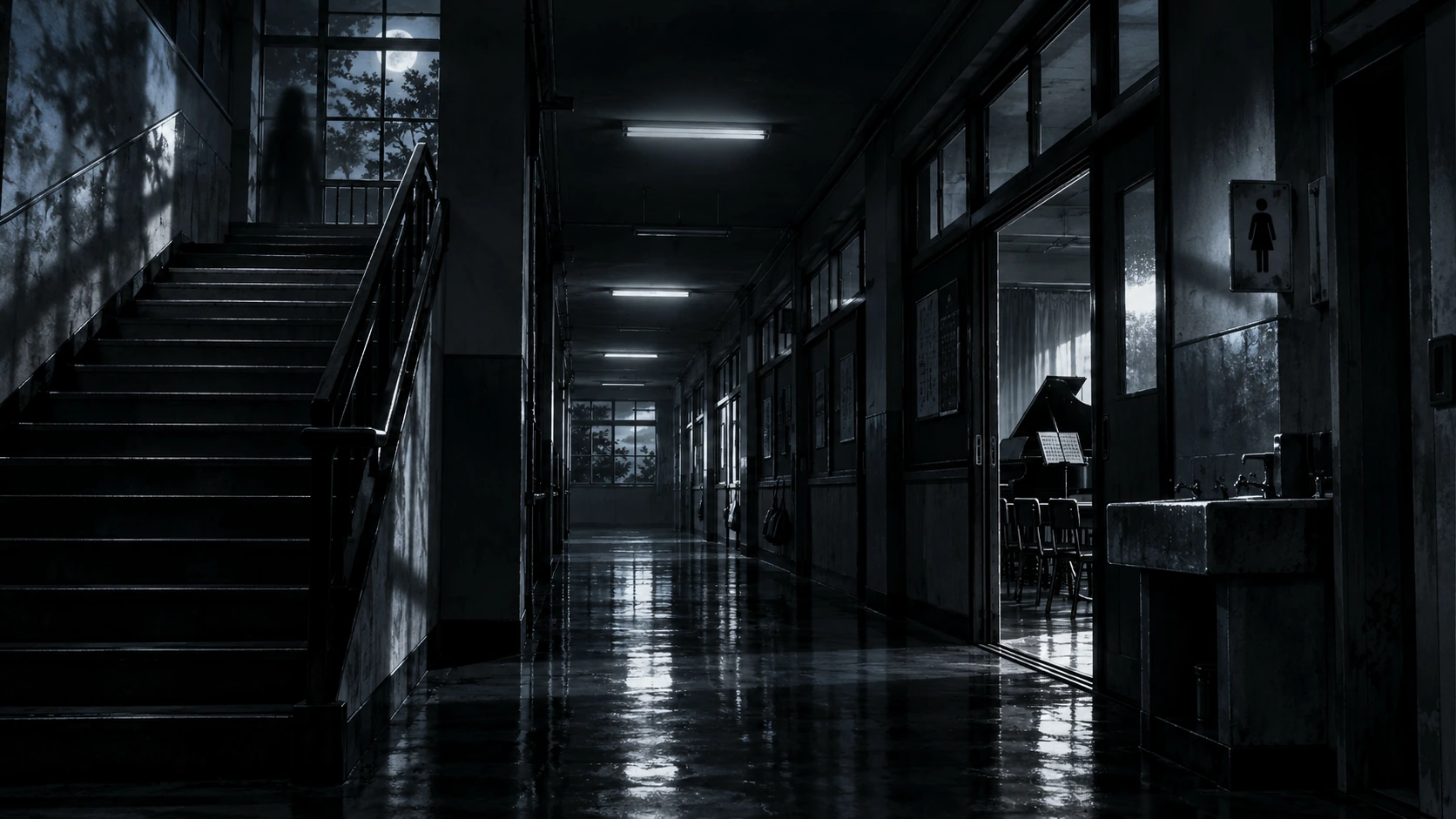
Konaka explicitly identifies the school corridor as his own choice for the adaptation, rather than simply the inherited setting of the version he describes. He also distinguishes an explanation invented for the production from material he had encountered. The creator marks a boundary that later summaries can blur.
Working backwards from a familiar image can make a successful adaptation look ancient. Even a change of location can arise from the practical task of turning a narrated encounter into a filmable scene. That does not make one medium authentic and another false. It gives us a documented decision within a process of change.
This account stops us from simply projecting a familiar corridor image backwards into an older sighting. It does not establish that Konaka independently invented every corridor variant anywhere. His testimony concerns the material he knew and the production he made. Respecting a creator’s distinction between inherited material and invention includes respecting the limits of that testimony. It is evidence of one identifiable decision, rather than a complete map of all possible precedents.
A mirror changes the encounter
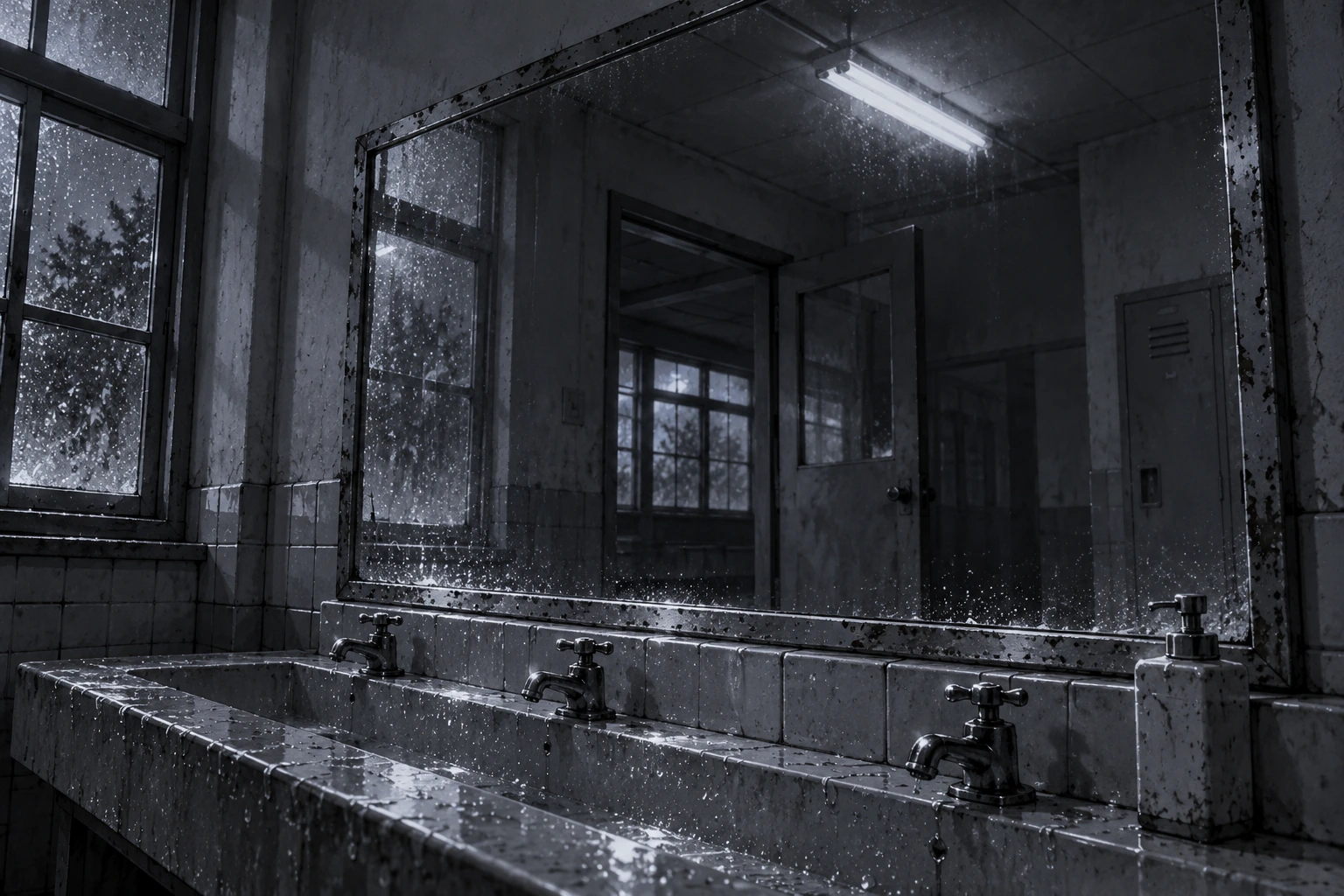
Nichibunken record 2610026 summarises a 2001 paper credited to 降井直人 concerning Kobe Municipal Rokkō Island High School. Eye contact with Teke-teke-san in a mirror triggers pursuit. The short record places a mirror and a gaze at the encounter’s centre.
It does not, in its summary, provide a railway accident or an individual’s biography. Classifying every account simply as a railway legend would lose this difference. Yet I have not read the full original paper, so its silence in the summary cannot establish that no backstory appeared in the complete telling.
A teller and listeners can remember different stories
Satō Kikuichirō’s 2022 paper compares a teacher’s school stories with former pupils’ recollections. Its discussion of Teke-teke includes changes of location for different audiences and discrepancies between accounts of what was heard.
One school cannot supply a national diffusion history. It can reveal why listeners who apparently share a source later possess different versions. If we were collecting another account, the plot alone would be insufficient: when, from whom and in what setting it was heard would matter too. A remembered source name does not guarantee unchanged narrative content.
A teller’s intention and a listener’s lasting impression need not be identical. Could a story relocated near its audience later be remembered as an event belonging to their own school? That is my question prompted by the cases discussed, not a diagnosis that all graduates remember incorrectly. The social setting of a telling may help move the apparent setting of the story. That possibility deserves investigation separately from the truth of a supernatural encounter.
Names and narrative rules need separate comparisons
The repeating sound of the name suggests movement and pursuit to my ear. That is a reading of its effect, not an established etymology, a named inventor or proof of a dialect origin. Recorded uses of the sound should come before an attractive origin story about it.
The same caution applies to Kashima-san. The catalogue and description of Matsuyama Hiroshi’s Kashima-san o ou introduce a visiting and questioning structure directed at a person who has heard the story. Similar figures need not imply identical rules. I have not read the complete book and cannot use its catalogue to reconstruct every variant or establish a direct lineage.
A brief repeated sound may be easy to retell, but memorability alone does not explain which details could disappear while the name survived. Comparing actions—looking into a mirror, being pursued, hearing a voice—would help distinguish a shared label from a shared encounter mechanism. These are comparison criteria, not a newly discovered list of universal traits. An impression of how a name sounds is a starting question for transmission research, not proof of how transmission occurred.
A bounded timeline is still useful
The contents listing of Kowasugiru hanashi, published in 2012, also includes the name Teke-teke. It is another publication record, not the earliest example. Production recollection, a 2001 collection summary and a 2022 investigation belong on a timeline with their source types still attached.
These materials do not identify the first teller, year or locality. They do support more specific questions: how adaptation changes a setting, how a school account changes the conditions of encounter, and how recollection changes a telling. Rather than dwell on bodily injury, I find the mechanism by which a story moves closer to its listeners more revealing.
Sources and scope
- 小中千昭「妖怪テケテケ」Introduction
- 降井直人「現代人と世間話」:日文研DB 2610026
- 佐藤喜久一郎「『学校の怪談』の記憶とそのリアリティー」
- 松山ひろし『カシマさんを追う』書誌・内容紹介
- 松山ひろし『怖すぎる話』書誌・内容細目
The creator’s recollection, official mirror-variant summary and relevant Satō passages were checked. Matsuyama’s two books were checked only through bibliography and descriptions. A national first appearance, birthplace, particular accident and direct lineage from Kashima-san remain unestablished.