IN 3 LINES
- TANUKI: Pon’s Summer launched November 10, with a BMX-riding tanuki delivering mail around a fictional Japanese island.
- Different packages shape delivery choices, while rewards from jobs and social activities help restore a shrine.
- Its promising connection is between learning routes and caring about a community; repetition and deadline pressure remain untested.
A package needs to reach its destination, but a tempting ramp offers a reason to take a detour. TANUKI: Pon’s Summer puts both impulses onto the same bicycle. Developed by Denkiworks and published by CRITICAL REFLEX, the game launched November 10, 2026; Steam lists it as available to purchase on November 12. Its protagonist, Pon, is a mail-delivery tanuki preparing for a summer festival on a fictional Japanese island. Official product page
Calling it a cute delivery game leaves out an important connection. The official description ties transportation constraints, BMX tricks, activities with residents and shrine restoration into the same daily life. This article examines that structure through public sources. It is not a hands-on review: we have not tested bicycle handling, delivery difficulty or the amount of dialogue. The question is what those systems could contribute together, and what conditions would need to hold for their combination to feel rewarding rather than merely busy.
The publisher’s November 10 launch release confirms the game is out on PC and consoles and describes delivery, activities and rebuilding together. We use that release as the news event, rather than treating a prelaunch announcement as confirmation that every store had already unlocked. Launch announcement
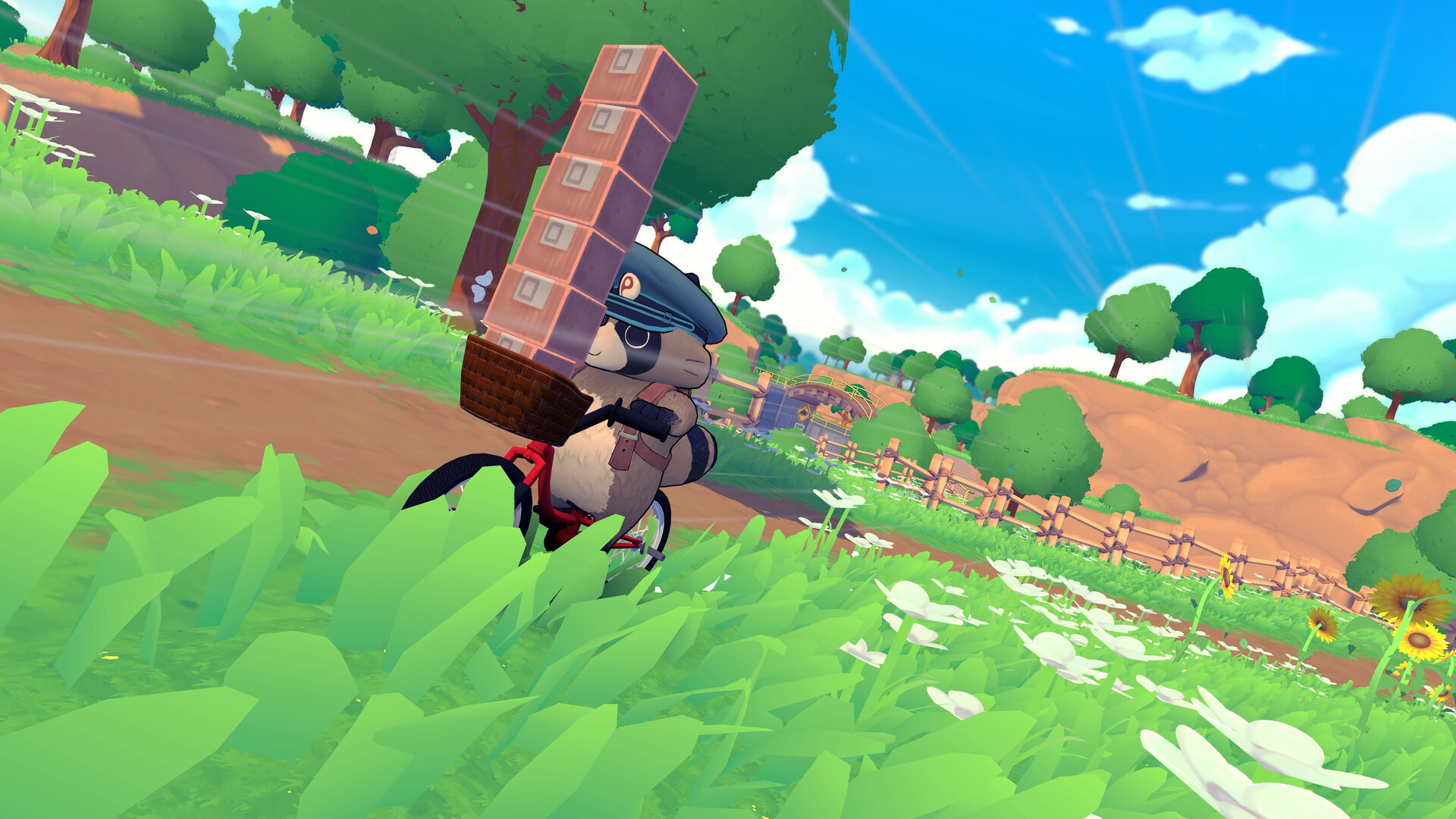
Official game screenshot of Pon riding with parcels. Image: Denkiworks / CRITICAL REFLEX, via the official Steam gallery. Unaltered; not our gameplay capture. — Source
A nimble bicycle with the responsibilities of cargo
Pon carries mail across an island inspired by Japan, rather than a documented reconstruction of one particular real town. Packages differ in size, weight and shape. The publisher’s release-date announcement says players must work out how to get them to their destinations. That introduces a reason to consider the journey itself, beyond clearing markers in an arbitrary order. Different things to carry can give the same stretch of ground different practical meanings. October 28 publisher announcement
The bicycle also supports play beyond transporting those packages. Official materials describe ramps, rail grinding and linked tricks, with more than one hundred BMX challenges. Routes toward deliveries and routes inviting performance consequently overlap on one island. The quantity is an announced feature, not proof of handling depth. Whether a failed trick feels worth retrying depends on its conditions, feedback and recovery cost. None of those qualities can be established simply by counting how many challenges the publisher lists.
The available description does not specify precisely which statistics change with each package. We are not claiming a measured reduction in acceleration, a particular penalty for dropping cargo or the existence of one optimal route. Keeping those details open separates a confirmed design constraint from an invented guide. It also leaves room for the actual game’s rules to be assessed on their own terms, instead of expecting them to behave like another delivery game whose systems happen to look familiar.
The publisher also presents the island as a love letter to Japan, drawing on the developers’ lived experience in Kyoto, Aomori, Sapporo and Beppu. It is a fictional setting assembled from experience, not a promise to reproduce one real tourist destination. That background matters when considering whether routes and destinations can feel like a lived-in place rather than an assortment of isolated challenges. Publisher game introduction
A new Kyoto studio with a relevant sporting history
The publisher describes Denkiworks as a Kyoto studio formed by three co-founders who had worked together on projects including Cursed to Golf. TANUKI is the team’s debut title. Their previous collaboration supplies context for the new studio; it should not erase the distinction between a person’s professional history and the catalog of the company that person subsequently helps establish.
Cursed to Golf, released in 2022, combines golf with repeated challenge: its official description requires finishing within a par count or returning to the course’s beginning. Its credited developer is Chuhai Labs, so calling it an earlier Denkiworks game would be inaccurate. The useful comparison is structural, rather than a claim that the two games share rules or difficulty. Both invite us to think about what a sporting action can accomplish outside a conventional sporting contest. Cursed to Golf’s official description
In the earlier title, limited shots frame a hazardous route. In TANUKI, BMX connects to errands and community life. We can compare those different uses without asserting that the creators explicitly described one as a continuation of the other’s philosophy. The link helps explain what to look for: the bicycle is not merely a faster walking animation. It is potentially a source of skill that can acquire another purpose when the player has someone to reach or something awkward to carry.
Analysis: delivery can turn scenery into routes worth learning
Our first argument combines package constraints with an environment offering tricks and alternative lines. Together, they could make topography matter in more than one way. A free ride invites a player toward whatever looks enjoyable. A destination and cargo add reasons to evaluate that same path differently. The route becomes a decision, rather than just a connection between the point where play happens and another point where a reward is collected. That possibility is an inference from the documented features.
A slope might be attractive during an exploratory ride and less attractive when completing a delivery takes priority. This is a hypothetical illustration, not confirmation of a particular optimal path in the game. The broader implication is that a world need not grow indefinitely to support richer exploration. If familiar ground develops new uses as skill and responsibilities change, a limited area can sustain meaningful decisions. Learning a place may then matter as much as discovering another place that the player has never visited.
The official product description also connects learning routes with getting to know the people along them and beginning to feel at home. That supplies a social dimension to geographical knowledge. A destination could become the home of someone recognizable rather than a coordinate. Repetition might then reinforce familiarity instead of simply repeating distance. We are interpreting an intended connection, not guaranteeing that players will develop affection for every resident or that the writing provides equal depth to every destination.
There is a plausible counterargument: cargo constraints could interrupt tricks so frequently that the activities compete rather than complement one another. Repeated journeys might become tiring before they become familiar. An impressive challenge count cannot resolve that tension by itself. The important practical questions are whether riding remains enjoyable while carrying out a responsibility, and whether failure invites another attempt. A system that makes routes memorable also needs to avoid making required travel feel like an obstacle between more appealing activities.
Analysis: returning personal rewards to a shared place
The second connection is the festival. Official descriptions have Pon restoring the Great Tanuki Shrine before the Great Tanuki Festival at summer’s end. Money and rewards from deliveries and activities can rebuild, upgrade and decorate it. Xbox’s November 3 announcement describes a one-month preparation period. That sets a seasonal horizon for progress, rather than presenting the shrine simply as an indefinitely expandable collection of upgrades. The exact consequences of that horizon still need to be distinguished from the premise. Official Xbox announcement
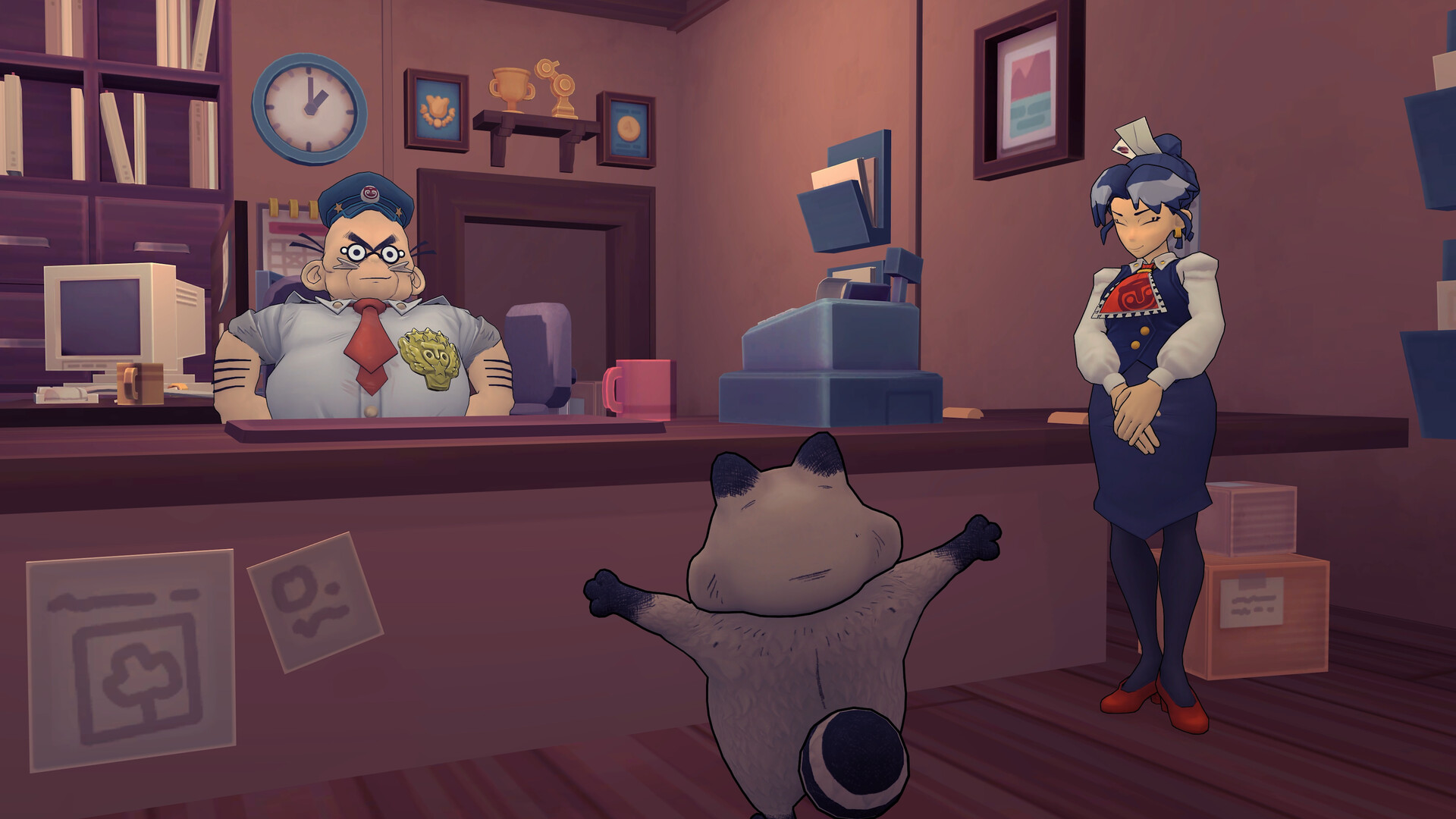
Social activities connect to the same goal. As relationships develop, residents invite Pon to activities including baseball, sumo and making sushi, offering opportunities to earn rewards for the shrine. Xbox’s release-week calendar also links friendship and requests with restoration items and rewards. This gives the connection corroborating platform information, although the calendar is not an independent hands-on assessment of how satisfying those rewards feel. The documented point is that social play and rebuilding are designed to interact. Xbox release-week calendar
Our interpretation is that this can change how progress is perceived. Instead of only increasing a personal total, work helps shape a place where others can gather. The official description explicitly presents the completed shrine as somewhere to welcome people met during the season. Returning the proceeds of small tasks to the setting of future interaction could give those errands a legible destination. It is a proposed loop between earning, building and meeting people, rather than a claim that the game models a real island economy or real religious practice.
A different reading is possible. If every conversation becomes a means of obtaining a required item, community life can turn into an efficient checklist. A month-long horizon might convey pleasant seasonality for one player and fear of missing out for another. We have not established from these sources exactly how days advance or what happens if preparation is incomplete. It would consequently be misleading to promise the absence of pressure, a particular fail state, or unrestricted opportunities to recover missed activities.
Calling the game relaxing does not settle those questions. Gentle-looking art and a player’s experienced workload are different things. Festival anticipation could become enjoyable motivation or an instruction to stop taking detours, depending on activity density and failure rules. That tension is another reason to examine the seasonal objective carefully. If the player’s preferred kind of wandering becomes something to avoid for efficiency, a system intended to connect island life may instead make its pleasures feel mutually exclusive.
Finding an entry point without overpromising access
Steam lists Japanese among supported languages and offers a demo route. The October 28 publisher announcement describes the demo as the opening three days, estimated at two to three hours, with save progress transferable at launch. That duration is the publisher’s estimate, not our timing. Current distribution and transfer conditions should be checked for the particular edition and storefront being used. A sample can help establish whether the basic interaction is comfortable without proving how varied the entire summer remains.
Xbox’s November 3 announcement names Game Pass Ultimate and PC Game Pass for November 10 access. That does not mean every subscription tier includes the game or that access grants permanent ownership at no cost. This is information for readers checking an existing subscription, not advice to purchase one. We have not compared regional prices across platforms; anyone buying the game should consult their own store’s language, device and pricing information rather than extending one platform’s announcement to all versions.
When sampling the game, a useful question is whether a delivery makes another route tempting, and whether meeting a resident helps a destination become memorable. These are criteria for examining personal fit, not effects we have already verified. Someone who wants uninterrupted trick practice may value the bicycle differently from someone who wants riding to feel embedded in a place. The same journey can therefore succeed or disappoint for different reasons, even when both players enjoy the visual style.
TANUKI’s most interesting proposition is the overlap between a road worth riding and a road leading to someone worth visiting. Packages and a festival could give each trip a reason instead of merely limiting freedom. If a player arrives for the appealing tanuki and gradually learns the people as well as the routes, delivery could become a way to develop a relationship with a town. Whether the released game sustains that connection is the question to carry beyond its launch announcement.