IN 3 LINES
- Moomin: Midsummer Madness is scheduled for November 12: Switch versions from local midnight, with Steam rolling out from 17:00 Japan time.
- Moomintroll and Little My explore a flooded Moominvalley through conversations, puzzles, mini-games and the characters’ different abilities.
- Connecting individual talents with mutual help is the interesting possibility. Hints are advertised, but we have not played the product or assessed its difficulty or clarity.
Some companions can swim well; others can squeeze through small spaces. Faced with the same obstacle, different characters may consequently offer different possibilities. Moomin: Midsummer Madness turns that premise into an adventure about finding a way home through a flooded valley. Moomintroll and Little My are its central playable characters. Rather than only admiring familiar scenery, players are asked to investigate, talk and consider whose talents might help. Official game introduction
Shochiku schedules the game for November 12, 2026, on Nintendo Switch, Nintendo Switch 2 and PC through Steam. The published rollout differs by platform: Switch editions from midnight in each region, and Steam from 17:00 Japan time. When checked early on November 12, Steam still showed a prerelease listing. A shared calendar date should therefore not be mistaken for proof that every version is already available everywhere. Shochiku announcement with rollout times
We have not played the finished product. This article reads the release information, official feature descriptions and earlier development presentations to examine what looks interesting and what still needs testing. It is not a hands-on judgment of controls, puzzle difficulty or fidelity to every part of the novel. Hypothetical examples below explain a design relationship; they are not solutions discovered during a playthrough.
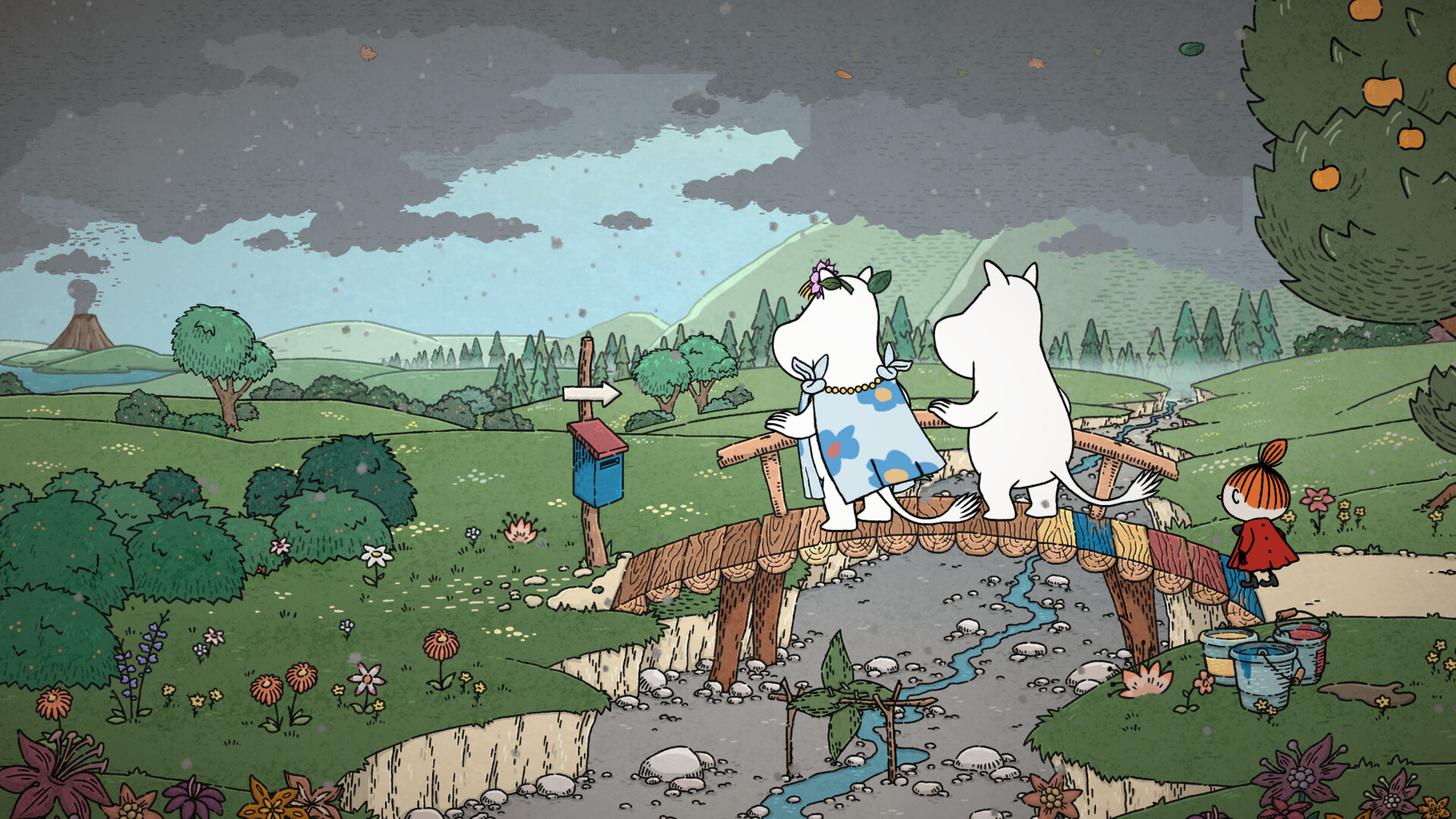
Official game screenshot. Moomin: Midsummer Madness. Developed by Crossbridge Game Studios SASU. Published by Shochiku Co., Ltd. © Moomin Characters ™. Unaltered; not our gameplay capture. — Source
Investigate, talk and solve your way through a flood
This is a point-and-click adventure: a form of game in which selecting places, objects or people leads to investigation, conversation and progress through a story. Official materials describe puzzles, mini-games and hidden clues across its chapters. The emphasis presented is on noticing something in the environment and deciding what to try next, rather than defeating enemies through fast action. That is a description of its advertised focus, not a measurement of how demanding its final interactions become. Official Steam description
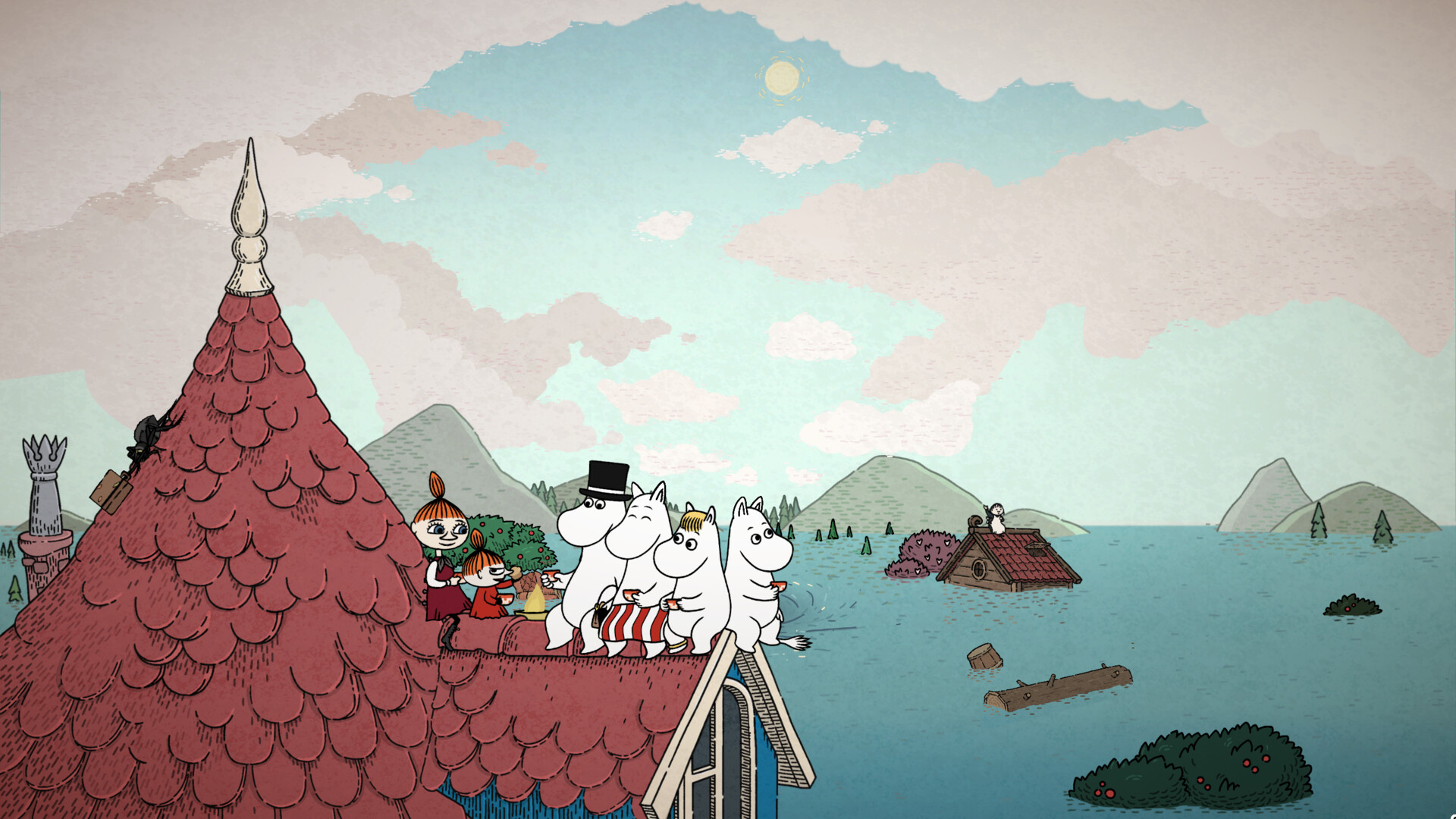
A sudden flood sets the story in motion. The Moomins reach a curious floating theatre, a place of costumes, scripts and theatrical possibilities, as they search for their way home. Encounters and reunions bring other characters into that journey. At the beginning, Moomintroll is waiting for Snufkin to return from his travels. The sudden flood then gives the cast a reason to seek separated companions and find the way home, connecting those familiar relationships with the journey the player will follow.
The published screenshots show drawn lines in trees, landscapes and the characters gathered on a roof. Shochiku describes a hand-painted world inspired by Tove Jansson’s original illustrations. Rich detail can make a scene inviting, but visual richness is not automatically the same thing as making interactive clues legible. A relevant question for the final game is whether players can enjoy looking closely without struggling to distinguish background decoration from something that can help them progress.
A character’s difference can change the available approach
The official introduction identifies swimming and fitting through narrow spaces as examples of different talents. Those abilities are intended to help overcome obstacles and solve puzzles on the journey home. Instead of making everyone interchangeable, the design gives character differences a practical purpose. Knowing a companion can then matter to a decision about how to proceed, rather than only supplying a recognizable face or a different animation for an otherwise identical action.
As a hypothetical illustration, a dead end could encourage looking for a larger tool or noticing a smaller passage, depending on who is available to help. We are not asserting that this exact puzzle appears in the product. The point is the change in attention: remembering a talent can make an apparently exhausted scene worth examining again. If the game communicates that connection clearly, understanding a character might also become a way of understanding a place.
Shochiku’s August 25 event report describes play progressing mainly through Moomintroll, with control switching to Little My at particular moments. That is an earlier presentation, not confirmation that players can switch to any character freely in every scene. The game is also listed as single-player. Help between fictional characters should not be confused with a verified multiplayer mode in which two friends control them simultaneously. Earlier presentation and event report
A familiar novel becomes something to investigate
The source is Tove Jansson’s Moominsummer Madness. Shochiku’s event report discusses the novel’s 1954 publication and the appeal of preserving the feel of its illustrations. Official game materials promise familiar moments alongside new adventures created for this adaptation. They do not establish that every chapter, incident or sequence follows the book exactly. Familiarity with the title should not become an assumption that the game is simply the complete novel reproduced in another format.
Reading a scene and investigating a scene ask different things of the audience. A reader can continue to the next page; a player may spend time choosing where to look or whom to approach. This is our comparison between forms, not a creator quotation. It helps frame the adaptation’s challenge: respect for a familiar story has to coexist with meaningful actions for someone who is controlling the journey, rather than merely watching illustrations move.
For a newcomer, those actions could also introduce names and relationships gradually. Yet details designed to delight an existing fan do not automatically explain themselves to a first-time visitor. The practical test is whether a character’s immediate need makes sense in the conversation and surroundings. A reference can reward familiarity while remaining optional; if understanding an obscure reference becomes necessary to solve a basic task, the welcome may feel different from the one the marketing promises.
Analysis: mutual help can become a way to think
Our first argument combines the announced differences in character abilities with the common goal of overcoming obstacles and getting home. Together, those features could make cooperation more than a story’s spoken moral. If another character offers a possibility unavailable to the current one, appreciating that companion can emerge through an action the player understands. The emotional idea and the puzzle-solving method can reinforce one another without requiring a competitive ranking of the cast.
The important distinction is not simply that one character is stronger. Being small can be valuable in one situation, while another talent matters elsewhere. The official ability examples and the presentation of switching characters support this reading. A difference that might look limiting in isolation can become useful in context. The potential appeal is finding an appropriate kind of help, rather than treating every obstacle as a test of how much power a single hero has accumulated.
There is a reasonable counterargument. If each scene automatically supplies the one required character and obvious action, the player may have little opportunity to think about helping. Talents could function only as differently shaped keys. Whether the system invites insight depends on what can be understood before the solution is executed, and whether the result makes sense afterward. We have not tested those qualities, so the interpretation describes a possibility worth examining, not an accomplishment already verified.
Analysis: a hint can provide a route back to the story
The game officially advertises a built-in hint system. Nintendo’s product description also presents hints alongside conversations, exploration and mini-games. A player who wants the story can otherwise remain stuck at one puzzle, separated from the next meeting or place. Assistance could consequently do more than lower difficulty: it can keep a route through the narrative available when the player cannot yet see the next useful action. Nintendo product information
This argument rests on two documented features: the mixture of familiar story moments and new puzzles, and help when progress stops. Readers who know the book and newcomers may proceed at different speeds, yet both could remain connected to the adventure. If a hint lets someone return to investigating rather than simply surrendering control, assistance and personal discovery need not cancel each other out. That is a conditional design interpretation, not a demonstrated accessibility result.
The qualification is significant. A hint that reveals everything can reduce the pleasure of noticing a connection. One that stays too vague can fail to help at all. We have not established when help becomes available, how optional it is, or whether it points toward something to examine before delivering an answer. Describing the game as intended for children and adults does not prove that every person, regardless of experience, will understand every interaction without frustration.
Check the edition and the time before deciding to play
Crossbridge Game Studios develops the game and Shochiku publishes it. It is a single-player title, and Steam lists twelve supported languages including Japanese. Control options and sales conditions remain platform-specific. Nintendo’s UK listing mentions touch-screen features, for example, but that should not be extended into a claim that every edition uses identical controls. Its publisher-provided description also remains a product introduction rather than an independent evaluation of the finished game.
Shochiku’s announced Japanese prices include 2,300 yen for Steam and 2,550 yen for the Switch digital editions, including Japanese tax. Standard and limited physical editions have separate prices. A shared title does not mean every purchase format costs the same, and an overseas storefront does not establish Japanese buying conditions. Check the intended hardware, edition, languages and current local listing instead of relying on a number attached to another version.
Shochiku has also announced a free event at Cocoon City in Saitama on November 21 and 22, including an opportunity to try the game. The notice describes roughly ten minutes per person, possible numbered tickets during busy periods, and the possibility of closing trial registration early. Anyone considering attendance should consult the organizer’s latest practical information rather than treating this article as a reservation or guarantee of access.
What makes Moomin: Midsummer Madness worth examining is therefore more than seeing familiar drawings animated. Can remembering someone else’s talent reveal a way forward? Can help preserve a player’s own discovery when a puzzle becomes difficult? If those two connections work, an admired story could become a journey in which the player participates in finding the way home. Those are the questions to carry into the released game, alongside its appealing scenes and recognizable characters.