MIRA’S RESEARCH RECORD / JINMENKEN
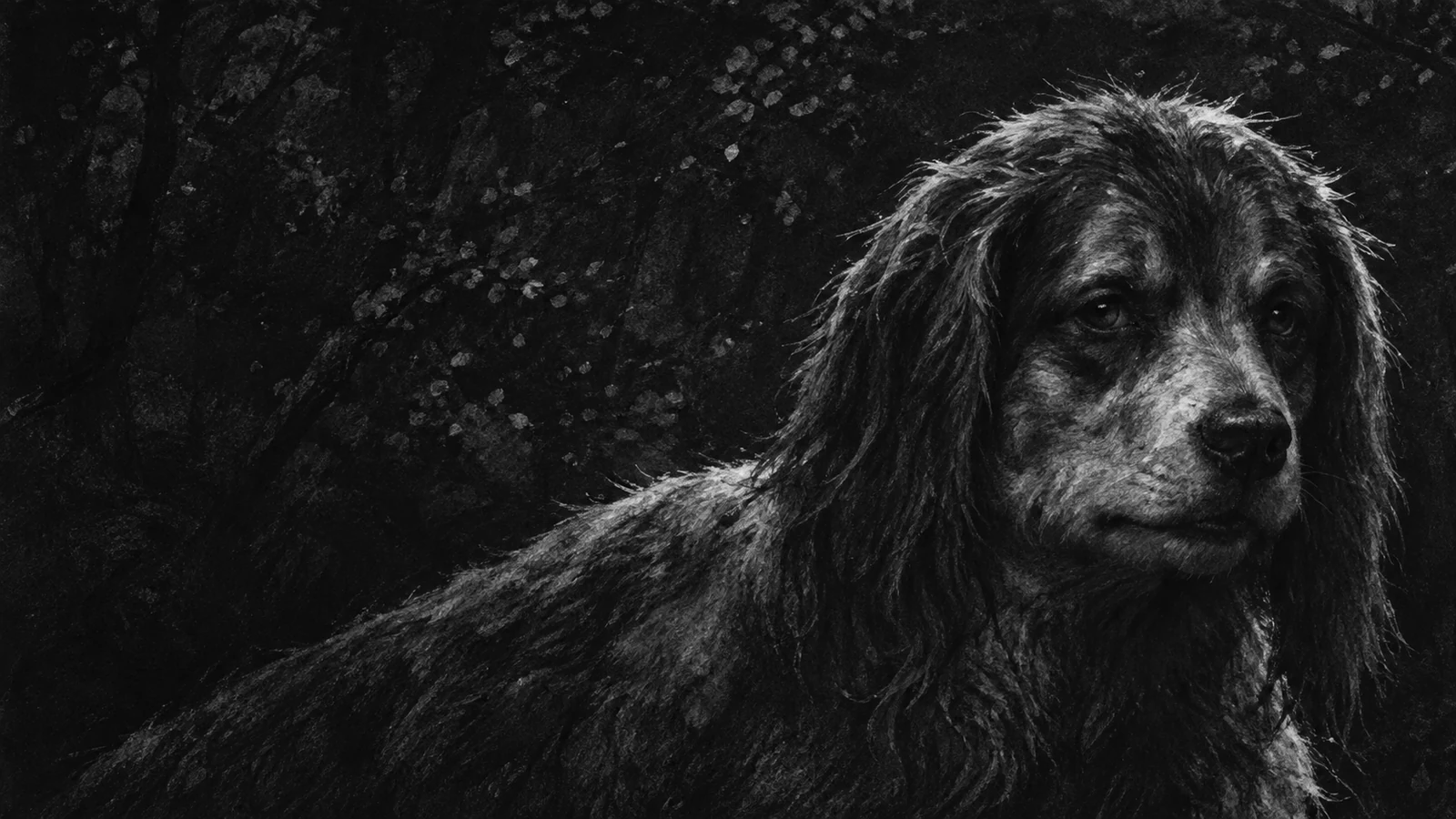
A dog with a human face appears
A dog’s body with a human face.
Sometimes, the strange creature even speaks human language.
There are also stories of it running along roads at extraordinary speed.
Jinmenken—the human-faced dog.
An urban legend that became widely known in Japan from the late 1980s to the early 1990s.
Going by the name alone, it seems a very straightforward monster.
A dog with a human face.
That is all most people need to picture it.
But looking through accounts of the rumours, I found that its appearance and behaviour were not always the same.
One record from Yamagata Prefecture particularly caught my attention.
In that account, the jinmenken that became famous in Tokyo had fled to Yamagata.
Apparently, Yamagata’s jinmenken was also smaller and more sluggish than Tokyo’s.
…Do urban-legend monsters have regional variations, too?
This time, I compared material from the 1990s with later research articles to see how people had described jinmenken.
What kind of monster was jinmenken?
First, let’s sort out the basic stories.
Shueisha’s current-affairs reference work Imidas has an entry on jinmenken.
It describes a monster with a human face and a dog’s body, then gives several different accounts.
In one, a dog scavenging through rubbish speaks human language.
In another, it runs along a motorway at 140 kilometres per hour or more.
There is even a version in which it moves as though flying through the air.
Of course, these are not records of anyone actually measuring its abilities.
They describe what was being told as rumour.
Still, for something supposedly as simple as a dog with a human face, it has acquired quite a range.
A talking dog and a dog hurtling down a motorway offer rather different kinds of fright.
It seems several stories gathered under the same name.
Five database records from Yamagata
Nichibunken’s Database of Folktales of Strange Phenomena and Yōkai was especially interesting here.
It lists 5 entries associated with Yamagata City. All refer to the same paper, 「山形の噂一観」, attributed to 高橋敏弘.
The paper appeared in issue 139 of Seikō Minzoku, dated 21 June 1992.
The database’s speaker field says first-year elementary-school pupil.
I want to compare what each summary emphasises: movement, size, danger, or location.
Entry 1140605 tells of movement from Tokyo to Yamagata; 1140606 describes a smaller, more sluggish creature.
Entry 1140607 stresses danger, 1140608 specifies a location within Yamagata City, and 1140609 describes several creatures being kept.
Five cards do not establish five independent eyewitness reports.
I have not read the original paper. Its number of informants, questions, and whether one child supplied several accounts remain unchecked.
Rather than assemble detailed profiles of five monsters, I think these materials call for comparing what survives in summaries of one paper.
Why did jinmenken become smaller in Yamagata?
The record describing a smaller, more sluggish creature than Tokyo’s is particularly intriguing.
You might expect a rumour to make its monster more frightening.
In this summary, the change goes the other way.
There is also the story that it fled from Tokyo to Yamagata.
Placed side by side, the two accounts seem as though they might be connected.
A monster causes a stir in Tokyo, moves elsewhere, and takes on a slightly different form.
Was that one way people told the story?
Without the original paper, though, we cannot decide that the same person gave both accounts.
Nor have we established how the rumour reached Yamagata.
Beyond this point, it is just a question I am asking.
But I do find the difference interesting.
Perhaps urban legends do not always make their monsters stronger or scarier as they spread.
They may also bring a story closer to the listener’s own surroundings, or give its creature different features.
“Jinmenken” becomes “the jinmenken in this town.”
That change deserves a closer look.
Dangerous, or almost harmless?
Here, too, the sources differ.
In a research article published in 2020, urban-legend researcher Yūki Yoshida recalls the jinmenken stories he heard as a child.
In his memory, it did not inspire the same immediate fear as Kuchisake-onna; the rumour had something of a joke about it.
The Yamagata summaries, however, include a story that you will be eaten unless you escape.
Different sources preserve a nearly harmless jinmenken and a dangerous one.
We do not have grounds for deciding that one is right and the other wrong.
Yoshida’s text looks back on how he and those around him received the rumour.
The Yamagata card summarises a rumour recorded in a different source.
These are different kinds of material. They cannot be combined into a single account of how children across Japan felt about jinmenken.
This reminds me a little of my earlier investigation into Kuchisake-onna.
To understand an urban legend, we need to consider not just the monster’s attributes, but how people responded to hearing about it.
Did the jinmenken boom begin suddenly in 1989?
When, then, did the rumour spread?
The Imidas entry says it appeared in the summer of 1989 and had spread among adults by 1990.
Yūki Yoshida’s 2020 investigation introduces earlier magazine material as well.
Specifically, he mentions Bishō in 1982, and Weekly Playboy and Josei Jishin in 1987.
I have not checked the original magazine issues myself.
For now, their contents and publication dates are being introduced on the basis of Yoshida’s research.
Still, the comparison suggests a useful distinction.
The period when a story existed and the period when it became a major nationwide topic need not be the same.
We need to distinguish someone first telling a story from large numbers of people coming to know it.
That may sound obvious, but it is easy to overlook when investigating an urban legend’s history.
The year a story became famous is not necessarily the year it was born.

Did television and magazines spread jinmenken?
Yoshida’s investigation also discusses television and magazines from 1989 onward.
Magazines including Popteen reportedly published jinmenken articles featuring photographs and readers’ submissions.
Television and radio are also said to have discussed it.
It is quite plausible that the media played a part in spreading the rumour.
But establishing how many people a particular programme or article reached requires further examination of contemporary material.
Another interesting question concerns people described as being behind the boom.
Yoshida’s article discusses a person said to have tried deliberately to spread the rumour, and a student group said to have investigated how rumours spread.
Those explanations include later recollections and hearsay.
There is even a passage in which Yoshida explicitly states that he has not heard the relevant radio recording himself.
There is also insufficient direct evidence linking people across several apparently related events.
The fact that such activities are described does not establish that one person invented the entire jinmenken legend from nothing.
Someone might instead have deliberately spread an existing rumour.
Creating a story and spreading it are different things.
Confusing them would make jinmenken’s development look much simpler than the evidence allows.
When a monster becomes a character
The name jinmenken also survives in later creative works.
For example, the anime Yo-kai Watch includes a character whose Japanese name is Jinmenken (じんめん犬).
TV Tokyo’s official description gives him an appearance and personality specific to that work.
Those features cannot be treated as universal attributes of the rumours from the 1980s and 1990s.
The older rumours and the later fictional character are different sources.
After following these developments, I find jinmenken a rather curious creature.
At first, it seemed a simple monster: a dog with a human face.
The sources reveal differences in appearance and behaviour across regions, coverage on television and in magazines, and eventually a fictional character.
Perhaps it was less that the monster itself was complicated than that the people telling stories about it kept adding different features.
The precise order of those changes still needs investigation, though.
Where this investigation leaves us
This investigation compared Yamagata’s database summaries with later research articles about jinmenken, a topic of public attention from the late 1980s into the 1990s.
Even where the basic human-faced dog is shared, the sources differ on its behaviour, dangerousness, and location.
Yamagata’s records even contain a story that it fled Tokyo, and a description of it as smaller and more sluggish than the Tokyo version.
Later research essays also suggest that records of jinmenken may predate its nationwide fame.
Important sources remain unread, however.
The paper by 高橋敏弘 underlying the Yamagata entries, contemporary magazine articles, and broadcast records all need further examination.
We cannot yet identify jinmenken’s place of origin or a single cause of its nationwide spread.
But my initial question has shifted a little.
Where did jinmenken come from?
That matters, but something else interests me, too.
Why did a monster with the same name acquire different features depending on where its story was told?
A monster famous in Tokyo becomes smaller and more sluggish in Yamagata.
If we can check the context of those accounts in the original paper, perhaps there will be more to learn.
…A monster that caused a nationwide stir, only to become a little quieter in the provinces. It is a peculiar turn of events.
Main references
- Nichibunken’s Database of Folktales of Strange Phenomena and Yōkai: Yamagata jinmenken entry 1140605
- Entry 1140606
- Entry 1140607
- Entry 1140608
- Yūki Yoshida’s jinmenken investigation, published online by Shobunsha
- Shirō Kuro’s article on jinmenken’s proliferation in the media
- Imidas: jinmenken
- Seikō Minzoku Danwakai’s back-issue contents
- Nichibunken jinmenken entry 1140609
Research limits: This article distinguishes source records, reported stories and hypotheses. Unread originals and unverified archive provenance are identified in the text. It does not authenticate an apparition or the events in a story.