MIRA’S RESEARCH RECORD / YUKI-ONNA
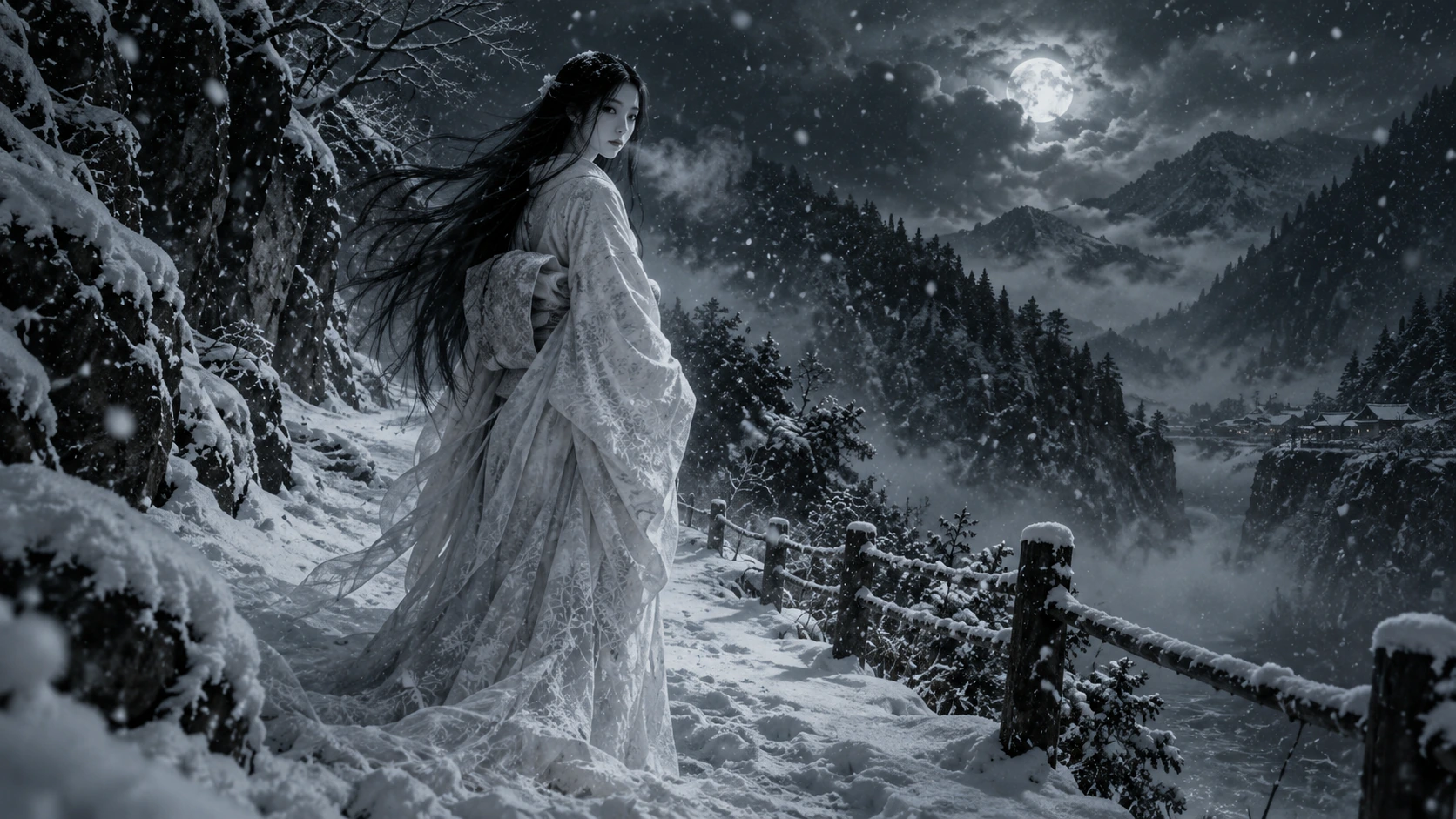
An unexpected place to begin
I expected a search for Yuki-onna to begin in a remote, deeply snowbound village. Instead, the useful starting point in Lafcadio Hearn’s Kwaidan is a short statement in the preface: Chōfu, in Nishitama district, Musashi province. The familiar story has a source note, not just a wintry setting.
That is not a licence to declare one birthplace for every Japanese snow woman. Where an author says he obtained a particular narrative and when a wider tradition began are different questions. I want to follow the route into the book before treating the book as a map of origins.
What the preface actually identifies
Hearn says a farmer from Chōfu told him the tale as a legend of the farmer’s home village. The preface is dated Tokyo, January 20, 1904. That brief statement does not supply the farmer’s personal name, the interview date or a transcript. It identifies a route of transmission without documenting every stage.
Hearn also says he does not know whether the story had previously been written in Japanese. That is uncertainty, not proof that no Japanese version existed. Turning his limited knowledge into a categorical claim would make our account more confident than its source.
Turning a place of transmission into a birthplace would change the farmer from the teller of one account into the apparent founder of an entire tradition. Hearn’s note makes no such claim. It may preserve only the last visible stage of a much longer journey. That gap is not an invitation to invent earlier narrators. It is part of what the source actually lets us know.
Chōfu is a name that needs historical context
The familiar modern city name Chōfu should not replace Hearn’s geographical wording automatically. His note specifies Nishitama district. Ōme’s Cultural Property News no. 426 connects the former Chōfu village with today’s Nagabuchi area and describes a Yuki-onna monument by Chōfu Bridge.
This helps interpret the name in the preface. A commemorative monument does not verify the events of the tale. A narrator’s home, a narrative setting and a later place of commemoration can all become associated with a story while remaining different kinds of location.
A figure and a narrative are not the same thing
In Yuki-Onna, an encounter during a blizzard is only the beginning. A spared young man carries a promise into his later domestic life, and breaking it matters. Fear of winter becomes a relationship with someone whose identity and conditions are not fully understood.
An image of a woman in white can preserve a recognisable figure while losing that narrative mechanism. For comparison, I find questions such as “What is demanded?” and “Under what condition does she depart?” more useful than deciding whose version has the longest hair. Similar appearance does not establish the same story.
The ending is not simply a punishment for a broken promise. O-Yuki spares Minokichi because of their sleeping children and leaves him responsible for their care. The terror of the first encounter becomes entangled with obligations created during their life together. Reading that turn matters more than treating the woman as a fixed emblem of coldness: the condition established at the beginning changes meaning inside a family.
A Tōno account has a different job
Tale 103 of Yanagita Kunio’s Tōno Monogatari describes Yuki-onna playing on the night of Little New Year or a winter full moon, accompanied by children. Village children are warned to return home early; the text also remarks that few people say they have seen her.
There is no reason to insert Hearn’s promise or family relationship into this account. Here the telling is connected to children staying outside after dark. Asking who invokes the name, and on what occasion, brings a social use into view that a catalogue of supernatural appearances would miss.
Regional records change the comparison
The official Nichibunken database summarises a 1956 Gunma record in which Yuki-onna is invoked when children will not sleep on a snowy night. A 1987 Miyama, Kyoto record instead concerns a woman appearing at a household preparing rice cakes and disappearing after the householder shouts. I read the database summaries, not the original publications.
Even this small comparison distinguishes a warning addressed to a child from a visitor at a threshold. Publication order cannot establish that the later record borrowed from Hearn. A narrative may be old when it is first collected; a late collection date is not a late birth certificate.
On comparable terms, different boundaries become visible: disclosing a secret in Hearn, returning home at night in Tōno, a child going to sleep in the Gunma summary, and a household entrance in the Miyama summary. These are not four universal types of Yuki-onna. They are four questions about action and boundaries that emerge from this small set of records. A shared name makes comparison possible without making every story interchangeable.

A route into print, not one universal origin
What I can trace is Hearn’s stated route into print, alongside accounts that give the same name different functions elsewhere. These sources do not establish a complete history of how every familiar modern Yuki-onna image spread from one work to another.
I began by looking for an address. What emerged was a set of junctions: a village account becoming literature, a name used in warnings, and an apparition remembered at a household boundary. They help explain why one recognisable figure can carry unlike stories. The connections between those junctions remain a subject for research rather than a line I can draw simply because the name matches.
Sources and scope
- Lafcadio Hearn, Kwaidan (1904): Introduction / Yuki-Onna
- 青梅市文化財ニュース 第426号
- 柳田國男『遠野物語』第17–19・103話
- 根岸謙之助「妖恠聞書」:日文研DB 1090014
- 西浦左門「丹波美山口碑集」:日文研DB 0700375
Hearn’s preface and story and Tōno tale 103 were read. Regional examples rely on official summaries and bibliography. The farmer’s identity, interview date, origin dates of variants and direct lines of influence remain unestablished.