MIRA’S RESEARCH RECORD / SCHOOL-SEVEN-MYSTERIES

A list of seven is not yet an explanation
Collecting seven familiar stories would make a tidy list. It would not tell me whose school the list belongs to. Replace one item with a story from another school and the apparent tradition may already be an editorial construction. This investigation concerns the framework, not a proposed universal set of seven.
Does the name describe a fixed inventory? Is a warning about learning the seventh item shared everywhere? Before counting, we need to know what counts as one story and whose record is being compared. A convenient list should not answer those questions on our behalf.
A record that already exceeds seven
Nichibunken record 2470061 summarises an account collected in Tsunemitsu Tōru’s 1986 paper from a male secondary-school student in Tokyo. Its “seven secrets” actually number more than seven. Remembering exactly seven is dangerous; knowing six or fewer, or eight or more, avoids the threat.
One database summary is not a national rule. It is, however, a counterexample to the assumption that the name must specify a collection’s size. Here a number governs the listener’s position in the story. Adding an eighth item can function as a way out rather than an error in counting.
In this version, adding a story does not necessarily increase danger: it can take the listener outside the dangerous total. Both fewer and more can be safer than exactly seven. Counting what one remembers thus becomes part of the narrative’s action. A listener need not see a ghost to participate; wondering how many stories one knows is enough. This is an interpretation of this particular recorded rule, not a claim about every school’s tradition.
Do not mistake a title for numerical dominance
Kiyomi Setsuko’s 2016 study counts numerals in a defined sample:104 of162 school ghost stories contain them. One, two and three are the most frequent; seven is not the leading number in that dataset. The scope matters as much as the result.
This does not date the expression “seven mysteries.” A number in a collection title and numbers indicating people, times or repetitions within a narrative do different work. Explaining everything through the supposed mystique of seven would erase those distinctions. The study gives us a check on an easy intuition, not a universal theory of the name.
A collection of seven tales and the seventh step of a staircase give a number different jobs: set size and location. These are illustrative examples of a distinction, not quotations from a particular collected account. Finding the same numeral would not by itself establish an identical legend. Conversely, a mechanism might survive when a numeral changes. That is why the role of a number matters alongside its frequency in a collection.
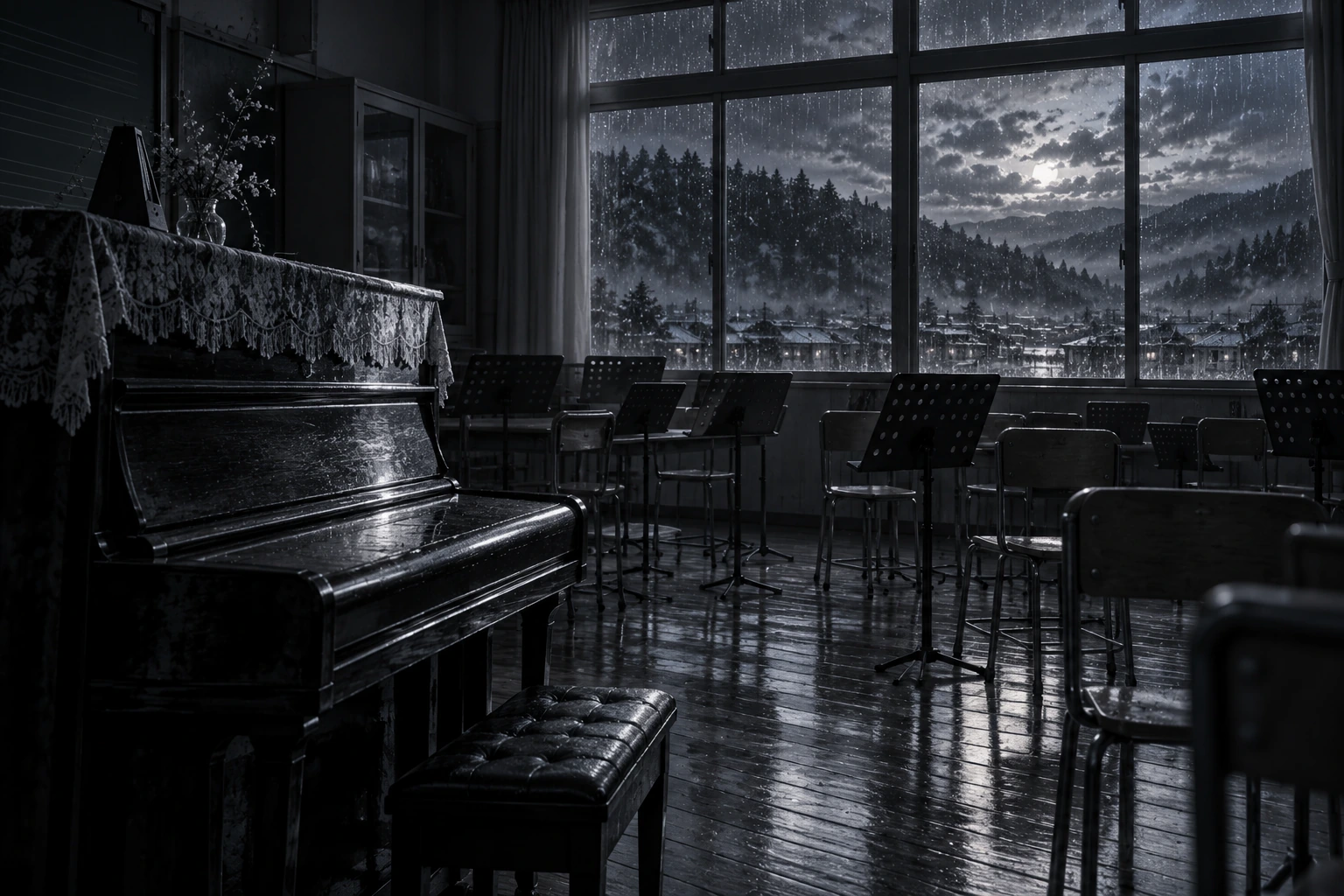
Different rooms invite different kinds of story
In his public lecture Minwa to kotoba, Tsunemitsu discusses specialist rooms and toilets as recurrent school-story settings and gives examples such as piano music from an empty music room. He does not present these observations as nationwide incidence statistics.
My interpretation is that shared school facilities offer reusable settings: a music room suggests sound, stairs suggest counting and movement, and a cubicle allows a voice without a visible speaker. That is a way to compare narrative devices. It does not mean every school tells every example. Similar architecture provides possibilities, not a guaranteed inventory.
How a portable idea becomes local
When comparing accounts, I would separate the room, time, participants and named source instead of recording only the monster’s name. The same label can point to different spaces, while similar events can travel through different routes. A comparison table should make those differences visible rather than flatten them.
A familiar building lets listeners supply concrete details from their own experience. That concreteness is not verification of an underlying incident. “I can picture the place” and “an event at that place has been independently established” are different statements. Keeping them apart helps explain a story’s local force without either endorsing or dismissing it.
A comparison between schools would also need to distinguish when an account was heard and which building a listener knew. I am not reporting a documented rebuilding here. The point is a design for further collection: a place name can remain stable while the space experienced by listeners changes. Keeping identification of a setting separate from verification of an event gives us more useful follow-up questions than asking only whether someone believes the story.
Publication is another stage, not a birth certificate
The National Diet Library catalogues Tsunemitsu’s Gakkō no kaidan 3 as an April 1993 publication and mentions school seven mysteries in its description. This establishes the existence and subject of a book. It does not establish the contents of every story, or an origin date for the tradition. I have not read that volume’s full text.
Printed collections acquire an order and headings. In conversation, one story can prompt a listener to contribute another. Investigating that difference would require comparing an actual printed set with records of actual tellings. We cannot assume the count remained fixed merely because both forms use the same familiar title.

What the framework helps us notice
These sources do not establish a single nationwide set of seven. They do show an account where more than seven stories coexist with a strict rule about seven, and observations of how school spaces support telling. A number can name a group or constrain a listener without counting a fixed contents list.
My working interpretation is that seven mysteries can operate as a framework into which local stories fit, rather than a sealed box of seven originals. Its historical introduction into schools remains a separate research question. An unsettled origin does not prevent us examining how the framework works in a particular recorded account.
Sources and scope
Individual database summaries, Kiyomi’s numeral analysis and the relevant lecture passage were checked. A universal seven-story set and the first use of the name remain unestablished. Gakkō no kaidan 3 has only been checked bibliographically; its unread arguments are not attributed here.